




Looking to boost your engineering career while earning top salaries? Canada is calling! From cutting-edge tech hubs to energy-rich provinces, the country is filled with In-Demand Jobs in Canada for engineers. Curious which roles pay the most and where opportunities are booming? Keep reading to discover the Top 10 Highest Paying Engineering Jobs in Canada and learn how you can land your dream role!
Table Of Content
1Are Engineering Jobs in demand in Canada?2Highest Paying Engineering Jobs in Canada3Engineering Jobs in Canada with Visa Sponsorship4How to Get Engineering Jobs in Canada?5Conclusion6Frequently Asked Questions
Are Engineering Jobs in demand in Canada?
Yes, engineering jobs are in demand in Canada, driven by ongoing infrastructure development, technological innovation, and skilled-worker shortages across provinces.
Fields such as civil, mechanical, electrical, software, industrial, and manufacturing engineering continue to see consistent hiring, creating excellent job opportunities in Canada across sectors like construction, renewable energy, IT, automation, and advanced manufacturing.
With many experienced professionals nearing retirement and large projects underway, Canada actively welcomes qualified engineers through immigration pathways like Express Entry, Provincial Nominee Programs, and employer-driven streams, making engineering one of the most promising career choices for newcomers.
Highest Paying Engineering Jobs in Canada
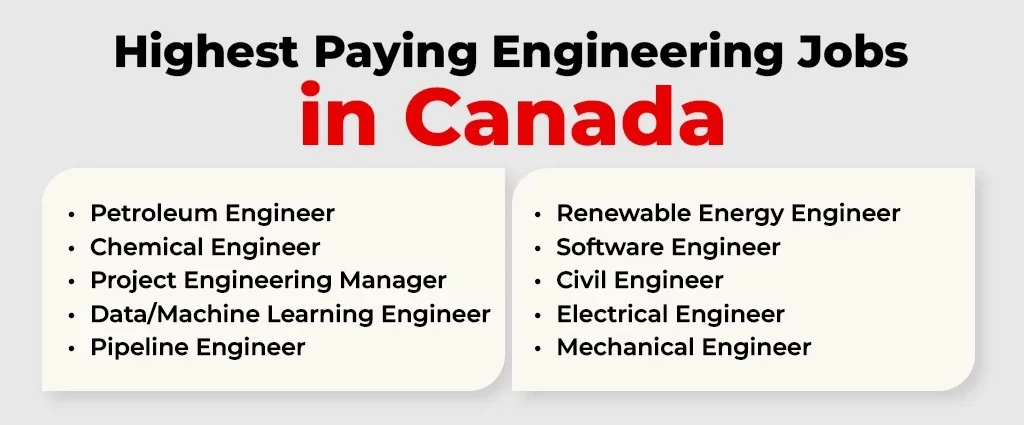
The Highest Paying Engineering Jobs in Canada are:
1. Petroleum Engineer
2. Chemical Engineer
3. Project Engineering Manager
4. Data/Machine Learning Engineer
5. Pipeline Engineer
6. Renewable Energy Engineer
7. Software Engineer
8. Civil Engineer
9. Electrical Engineer
10. Mechanical Engineer
Let’s see each job role in detail:
1. Petroleum Engineer
Petroleum engineers in Canada continue to find strong opportunities, especially in Alberta and Saskatchewan. They play a vital role in efficient extraction, production optimization, and cost control, with demand remaining steady as the sector adopts cleaner and smarter technologies.
Companies & Industry Scope
Petroleum engineers work with major energy companies, oil sands operators, engineering consultancies, and specialized service firms. With experience, they can progress into leadership, asset management, or strategic planning roles across the energy sector.
Petroleum Engineer Duties and Responsibilities
- Designing and planning drilling programs, well completions, and production strategies.
- Analyzing reservoir data, production performance, and economic feasibility of projects.
- Coordinating with geoscientists and field teams to improve recovery rates and minimize risks.
- Ensuring compliance with safety, environmental, and regulatory standards in field operations.
Petroleum Engineer Salary in Canada
The average salary of a Petroleum Engineer in Canada ranges from CAD 80,000 to CAD 200,000+ per year, depending on experience, location, and specialization.
- Entry-level: CAD 80,000 – 110,000 per year.
- Mid-level: CAD 120,000 – 150,000 per year.
- Senior level: CAD 150,000 – 200,000+ per year.
2. Chemical Engineer
Chemical engineers are in steady demand among engineering jobs in Canada, spanning energy, petrochemical, pharmaceutical, food processing, and manufacturing sectors. Demand remains strong as industries modernize, adopt cleaner technologies, and optimize production to stay globally competitive.
Companies & Industry Scope
Chemical engineers in Canada work across refineries, pharmaceuticals, food and beverage, chemical manufacturing, and environmental firms. With experience, they can move into R&D, plant management, process leadership, or specialized consulting roles.
Chemical Engineer Duties and Responsibilities
- Design and optimize chemical processes, equipment, and production lines.
- Monitor operations, troubleshoot issues, and improve efficiency and yield.
- Conduct safety, environmental, and quality assessments.
- Prepare technical reports, process documentation, and compliance records.
Chemical Engineer Salary in Canada
The average salary of a Chemical Engineer in Canada ranges from CAD 65,000 to CAD 160,000+ per year, influenced by sector and seniority.
- Entry-level: CAD 65,000 – 85,000 per year.
- Mid-level: CAD 95,000 – 125,000 per year.
- Senior level: CAD 125,000 – 160,000+ per year.
3. Project Engineering Manager
Project engineers in Canada are in high demand for managing complex projects end to end. They lead teams, coordinate stakeholders, and ensure timely, cost-effective delivery across construction, energy, utilities, and industrial sectors.
Companies & Industry Scope
Project engineers work with construction firms, EPC contractors, oil and gas companies, utilities, and infrastructure developers. With experience, they can advance into senior roles such as project director, engineering director, or operations manager.
Project Engineering Manager Duties and Responsibilities
- Lead engineering teams and coordinate design, planning, and execution.
- Manage project scope, timelines, budgets, and resources.
- Act as liaison with clients, contractors, regulators, and internal teams.
- Review deliverables, manage risks, and ensure safety and quality standards.
Project Engineering Manager Salary in Canada
The average salary of a Project Engineering Manager in Canada ranges from CAD 90,000 to CAD 175,000+ per year, depending on project size and sector.
- Entry-level/junior management: CAD 90,000 – 115,000 per year.
- Mid-level: CAD 120,000 – 150,000 per year.
- Senior level: CAD 150,000 – 175,000+ per year.
4. Data / Machine Learning Engineer
Data and machine learning engineers in Canada are in strong demand as companies adopt AI and digital solutions. They build scalable data systems and ML pipelines that drive analytics, automation, and smarter decision-making across industries.
Companies & Industry Scope
Data and ML engineers are highly sought among engineering jobs in Canada, working across tech firms, finance, healthcare, e-commerce, and SaaS companies. With experience, they can advance into senior ML roles, data architecture, AI platform leadership, or technical management positions.
Data / Machine Learning Engineer Duties and Responsibilities
- Design and maintain data pipelines, warehouses, and ETL processes.
- Develop, train, and optimize machine learning models for real-world use.
- Deploy and monitor models in production for performance and scalability.
- Collaborate with teams to translate business needs into data-driven solutions.
Data / Machine Learning Engineer Salary in Canada
The average salary of a Data / Machine Learning Engineer in Canada ranges from CAD 80,000 to CAD 165,000+ per year, varying by domain and seniority.
- Entry-level: CAD 80,000 – 105,000 per year.
- Mid-level: CAD 110,000 – 135,000 per year.
- Senior level: CAD 135,000 – 165,000+ per year.
5. Pipeline Engineer
Pipeline engineers in Canada play a key role in designing and maintaining safe, efficient energy transport systems. Demand stays strong, especially in Western provinces, driven by new projects, upgrades, and strict safety and environmental standards.
Companies & Industry Scope
Pipeline engineers work with pipeline operators, oil and gas companies, engineering consultancies, and construction firms. With experience, they can move into project management, integrity management, or regulatory leadership roles.
Pipeline Engineer Duties and Responsibilities
- Designing pipeline routes, specifications, and associated facilities.
- Performing stress analysis, risk assessments, and integrity evaluations.
- Preparing engineering drawings, technical specifications, and project documentation.
- Supporting construction, inspection, maintenance, and repair activities in the field.
Pipeline Engineer Salary in Canada
The average salary of a Pipeline Engineer in Canada ranges from CAD 85,000 to CAD 150,000+ per year, with higher ranges in energy-focused regions.
- Entry-level: CAD 85,000 – 105,000 per year.
- Mid-level: CAD 110,000 – 135,000 per year.
- Senior level: CAD 135,000 – 150,000+ per year.
6. Renewable Energy Engineer
Renewable energy engineers in Canada support Canada’s shift to solar, wind, hydro, and energy storage solutions. Demand is growing as investments increase in clean energy, efficiency, and sustainable infrastructure.
Companies & Industry Scope
Renewable energy engineers work with developers, utilities, consultancies, manufacturers, and government bodies. With experience, they can progress into roles such as project engineer, energy consultant, technical lead, or sustainability manager.
Renewable Energy Engineer Duties and Responsibilities
- Designing renewable energy systems and estimating performance and energy output.
- Conducting feasibility studies, site assessments, and technical evaluations.
- Preparing drawings, technical reports, and proposals for renewable projects.
- Supporting installation, commissioning, and performance monitoring of systems.
Renewable Energy Engineer Salary in Canada
The average salary of a Renewable Energy Engineer in Canada ranges from CAD 70,000 to CAD 155,000+ per year, influenced by project scale and technology.
- Entry-level: CAD 70,000 – 90,000 per year.
- Mid-level: CAD 95,000 – 125,000 per year.
- Senior level: CAD 125,000 – 155,000+ per year.
7. Software Engineer
Software engineers in Canada are in high demand, driven by a strong tech ecosystem and rapid digitalization. They develop applications and systems across industries, with demand supported by innovation in AI, cybersecurity, and cloud technologies.
Companies & Industry Scope
Software engineers are among the most sought-after engineering jobs in Canada, working with global tech companies, Canadian firms, banks, telecoms, e-commerce platforms, and startups. With experience, they can specialize in key domains and advance into roles such as technical lead, software architect, or engineering manager.
Software Engineer Duties and Responsibilities
- Designing, developing, testing, and maintaining software applications and systems.
- Writing clean, scalable, and efficient code while performing code reviews and debugging.
- Collaborating with product managers, designers, and QA teams to deliver new features.
- Ensuring application performance, security, and reliability in production environments.
Software Engineer Salary in Canada
The average salary of a Software Engineer in Canada typically ranges from CAD 55,000 to CAD 148,000+ per year, depending on level and employer.
- Entry-level: CAD 55,000 – 75,000 per year.
- Mid-level: CAD 80,000 – 110,000 per year.
- Senior level: CAD 110,000 – 148,000+ per year.
8. Civil Engineer
Civil engineers in Canada are integral to Canada’s infrastructure development, working on roads, bridges, buildings, water systems, and public transit projects. Population growth, urban expansion, and climate-resilience initiatives ensure steady demand for these professionals across the country. Their work directly impacts public safety, transportation efficiency, and quality of life.
Companies & Industry Scope
Civil engineers work with consultancies, construction firms, government bodies, and developers. They can specialize in areas like structural or transportation engineering and grow into project management, consulting, or senior infrastructure leadership roles.
Civil Engineer Duties and Responsibilities
- Plan, design, and review infrastructure projects like roads and bridges.
- Prepare drawings, specifications, and cost estimates.
- Supervise construction, conduct site inspections, and resolve issues.
- Ensure compliance with safety, building, and environmental regulations.
Civil Engineer Salary in Canada
The average salary of a Civil Engineer in Canada ranges from CAD 60,000 to CAD 156,000+ per year, influenced by specialization and project complexity.
- Entry-level: CAD 60,000 – 80,000 per year.
- Mid-level: CAD 90,000 – 120,000 per year.
- Senior level: CAD 120,000 – 156,000+ per year.
9. Electrical Engineer
Electrical engineers in Canada are in high demand due to growth in power systems, automation, telecommunications, and electric transport. Demand continues to rise with smart grids and renewable energy integration.
Companies & Industry Scope
Electrical engineers work with utilities, renewable firms, manufacturers, telecom providers, and consultancies. With experience, they can specialize and advance into senior engineering, project management, or technical expert roles.
Electrical Engineer Duties and Responsibilities
- Designing electrical systems, circuits, and control panels for various applications.
- Performing load calculations, protection coordination, and fault analysis.
- Preparing schematics, wiring diagrams, and technical documentation.
- Overseeing installation, testing, commissioning, and maintenance of electrical equipment.
Electrical Engineer Salary in Canada
The average salary of an Electrical Engineer in Canada ranges from CAD 65,000 to CAD 140,000+ per year, depending on sector and seniority.
- Entry-level: CAD 65,000 – 85,000 per year.
- Mid-level: CAD 95,000 – 115,000 per year.
- Senior level: CAD 115,000 – 140,000+ per year.
10. Mechanical Engineer
Mechanical engineers in Canada work across manufacturing, automotive, aerospace, HVAC, energy, and industrial sectors. Demand remains strong as industries modernize, automate processes, and adopt efficient, sustainable technologies.
Companies & Industry Scope
Mechanical engineers are in high demand among engineering jobs in Canada, working with manufacturers, automotive and aerospace firms, consultancies, HVAC contractors, and energy companies. They can specialize in design, plant engineering, or maintenance, progressing to senior, project management, or specialized technical roles.
Mechanical Engineer Duties and Responsibilities
- Design mechanical components and systems using engineering principles and CAD tools.
- Conduct calculations, simulations, and prototype testing to validate designs.
- Coordinate fabrication, installation, and commissioning of systems.
- Troubleshoot issues and implement improvements for better performance and efficiency.
Mechanical Engineer Salary in Canada
The average salary of a Mechanical Engineer in Canada ranges from CAD 60,000 to CAD 125,000+ per year, depending on industry and experience.
- Entry-level: CAD 60,000 – 80,000 per year.
- Mid-level: CAD 85,000 – 105,000 per year.
- Senior level: CAD 105,000 – 125,000+ per year.
Engineering Jobs in Canada with Visa Sponsorship
Many Canadian employers hire foreign engineers and support work visas through LMIA or global mobility programs when local talent is unavailable.
How It Works
- Employers usually need a positive Labour Market Impact Assessment (LMIA) to hire overseas engineers, proving no qualified Canadians are available.
- Some engineers are eligible under LMIA-exempt programs, including intra-company transfers, trade agreements, or the Global Talent Stream (for tech roles).
Engineering Roles Commonly Sponsored
- Civil Engineer – High demand in infrastructure projects (BC, Ontario, Nova Scotia)
- Software Engineer – In demand in tech hubs and banking sectors (Alberta, Ontario, Quebec)
- Mechanical Engineer – Manufacturing and energy roles (BC, Quebec, Atlantic provinces)
- Electrical Engineer – Utilities and renewable energy (Ontario, Manitoba, Northern regions)
Where to Find Sponsored Jobs
- Job boards often tag roles with “LMIA,” “visa sponsorship,” or “work permit support.”
- LinkedIn and Indeed list thousands of LMIA/visa sponsorship postings for engineers across Canada annually.
Tips to Improve Chances
- Target employers already advertising LMIA or visa-sponsorship roles.
- Align your profile with in-demand NOC code in Canada for engineers and pursue licensing or EIT/PEng eligibility if possible.
How to Get Engineering Jobs in Canada
Here’s the detailed process to get engineering jobs in Canada:
1. Know In-demand Jobs: Software, Civil, Mechanical, Electrical, Petroleum, Data, and Chemical engineers are highly sought across Canada.
2. Get Credentials Recognized: Complete an Educational Credential Assessment and start EIT/P.Eng. licensing with the provincial engineering body.
3. Build a Strong Resume: Highlight projects, technical skills, tools, and achievements in Canadian-style format.
4. Apply on Job Portals: Use Job Bank, LinkedIn, Indeed, and engineering recruitment agencies.
5. Network: Connect with engineers and professional groups to discover hidden opportunities.
6. Seek Visa Sponsorship: Target roles mentioning LMIA, work permit support, or visa sponsorship.
7. Prepare for Interviews: Review technical/behavioural questions, past projects, and Canadian standards.
8. Follow Immigration Updates: Skilled engineers are often prioritized for PR through Express Entry and PNPs.
Conclusion
Canada presents lucrative opportunities for engineers across top-paying In Demand Jobs in Canada, including software, civil, mechanical, electrical, petroleum, and specialized fields like data and chemical engineering. By recognizing credentials, targeting applications, and building a professional network, international engineers can thrive in Canada’s job market.
Explore current engineering opportunities on Job Bank
Frequently Asked Questions