




Canada has introduced significant Canada Express Entry changes in 2026, reshaping how candidates are selected for permanent residency. These updates affect the Canada immigration Express Entry system, targeted occupations, CRS scoring, and new priority categories.
If you’re planning for Canada PR, here’s a clear breakdown of what’s new and how it impacts your chances.
Table Of Content
1What Are the New Rules for Express Entry in Canada?2Canada Express Entry Categories 20263What changed in 2026 vs 20254Express Entry Targeted Occupations 20265Researchers and Senior Managers with Canadian Work Experience6Canada Express Entry Military Category7How These Canada Express Entry Changes Affect Your PR Chances8Final Takeaway9Frequently Asked Questions
What Are the New Rules for Express Entry in Canada?
The Canada immigration system has refined Express Entry to better match labour shortages and economic priorities. The major updates include:
- Category-based selection expanded: More draws now target specific occupations instead of only high CRS scores.
- Priority for Canadian work experience: Candidates with local experience are receiving preference.
- Focus on French proficiency: French-speaking applicants continue to get additional advantages.
- More frequent targeted draws: The latest Express Entry draw trends show smaller, occupation-specific rounds.
These changes mean that even candidates with a moderate CRS score may receive invitations if they belong to priority sectors.
Canada Express Entry Categories 2026
Canada’s Express Entry system in 2026 continues to use category‑based selection to target specific in‑demand occupations, alongside the usual human capital (general) and program‑specific (CEC, FSW, FSTW) draws.
Main Express Entry categories in 2026
The current categories (as of early 2026) are:
French‑language proficiency – candidates with strong French skills (usually at least CLB 7) in listening, speaking, reading, and writing.
Healthcare and social‑services occupations – nurses, allied health workers, behavioural‑support workers, and related roles; minimum 12 months of full‑time experience (up from 6 months).
STEM occupations – architects, software developers, data scientists, engineers, and other science/tech roles; also tightened to 12 months of experience.
Trade occupations – electricians, plumbers, carpenters, welders, etc.; cooks and chefs have been removed from this category.
Education occupations – teachers, early‑childhood educators, post‑secondary instructors; 12‑month experience requirement.
Transport occupations – pilots, flight‑related roles, aircraft mechanics, avionics technicians, and truck/bus mechanics (NOC 2021 codes such as 72600, 72404, 22313, 72410).
New 2026‑specific categories
In 2026 Canada added several targeted categories to plug major labour‑market gaps:
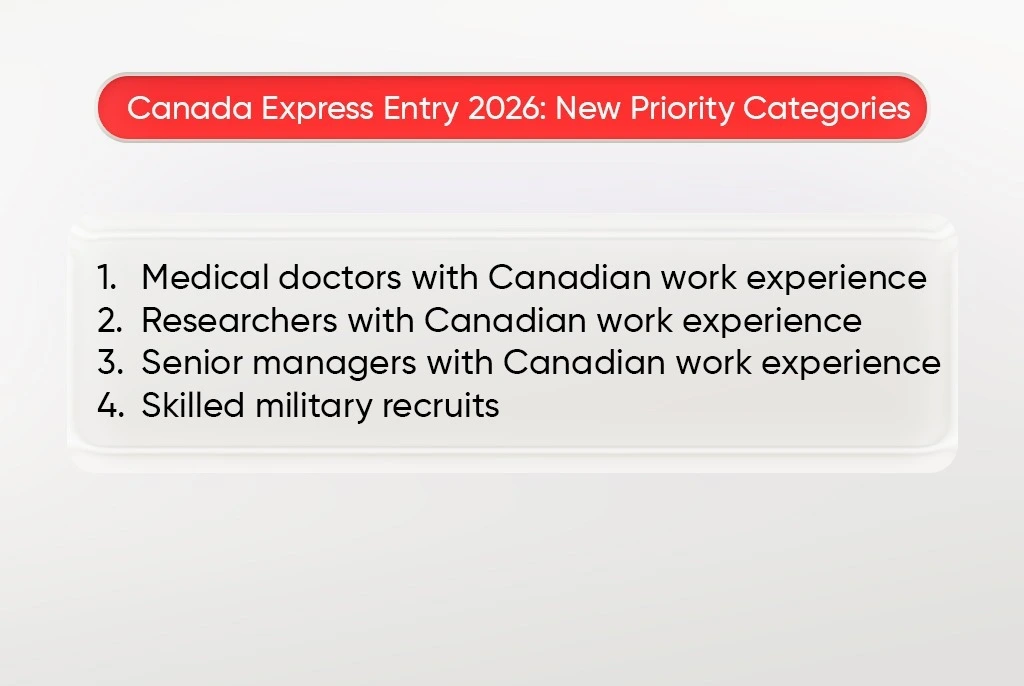
Medical doctors with Canadian work experience – family physicians, specialists, hospital‑based doctors, etc., with at least 12 months of full‑time work in Canada in the last 3 years.
Researchers with Canadian work experience – post‑doc, R&D, and innovation‑sector researchers with 12‑month Canadian experience.
Senior managers with Canadian work experience – managers in key sectors (tech, manufacturing, healthcare, etc.) with 12‑month Canadian managerial experience.
Skilled military recruits – foreign‑trained military personnel recruited by the Canadian Armed Forces for roles such as military doctors, nurses, pilots, and technical specialists.
What changed in 2026 vs 2025
The Canada Express Entry changes in 2026 introduced stricter eligibility rules and new targeted pathways compared to 2025. The goal of the Immigration, Refugees and Citizenship Canada reforms is to select candidates who can immediately fill critical labour shortages in Canada.
Here’s a clear comparison of what changed:
Tighter work‑experience rules: many categories now require 12 months of full‑time experience instead of 6, and this must usually be within the last 3 years.
New targeted categories added: doctors, researchers, senior managers, and skilled military recruits joined the mix.
Agriculture & agri‑food category retired: the agriculture‑focused category from 2025 has been removed.
Greater Emphasis on Canadian Work Experience: In 2026, candidates with prior Canadian work experience receive stronger preference in category-based draws.
Express Entry Targeted Occupations 2026
As part of the major Canada Express Entry changes, the Canada immigration Express Entry system in 2026 is targeting specific occupations through 10 category-based streams. These streams combine new priority groups with updated categories from previous years to address labour shortages across the country.
Most categories now require at least 12 months of full-time work experience within the last 3 years.
Medical Doctors with Canadian Work Experience
This new priority stream targets:
- Family physicians
- Medical specialists
- Licensed hospital doctors
Applicants must have 12 months of recent full-time work experience within the last 3 years in Canada, making this pathway ideal for doctors already practicing in the country.
Researchers with Canadian Work Experience
Canada is prioritizing innovation by inviting:
- Post-doctoral researchers
- R&D scientists
- Technology and innovation researchers
Candidates need 12 months of Canadian research experience, reflecting the country’s focus on knowledge-based industries.
Senior Managers with Canadian Work Experience
Senior-level professionals in key sectors now have a dedicated pathway, including managers in:
- Technology
- Manufacturing
- Healthcare
- Finance
A minimum of 12 months of Canadian managerial experience is required.
Transport Occupations
To support infrastructure and logistics, targeted roles include:
- Pilots
- Aircraft mechanics and inspectors
- Avionics technicians
- Truck and bus mechanics
These occupations are essential to Canada’s transport and aviation sectors.
Skilled Military Recruits
A new category focuses on foreign-trained military personnel recruited by the Canadian Armed Forces, including:
- Military doctors and nurses
- Pilots
- Engineering and technical specialists
This pathway supports defence workforce needs.
Healthcare and Social-Services Occupations
Healthcare remains one of the largest priority sectors. Eligible roles include:
- Registered nurses and nurse practitioners
- Allied health professionals
- Behavioural-support workers
- Social-service professionals
Unlike some categories, experience can be gained in Canada or abroad.
STEM Occupations
Science and technology professionals continue to be in high demand, including:
- Software developers
- Data scientists
- Engineers
- Architects
Candidates need at least 12 months of relevant experience.
Trade Occupations
Skilled trades essential to construction and industry are included:
- Electricians
- Plumbers
- Carpenters
- Welders
- Machinists
Agriculture-related trades are no longer a separate category.
Education Occupations
To address teacher shortages, Canada is inviting:
- School teachers (K–12)
- Early childhood educators
- Post-secondary instructors
A minimum of 12 months of experience is required.
Researchers and Senior Managers with Canadian Work Experience
Among the major Canada Express Entry changes, 2026 introduced priority pathways for highly skilled professionals already contributing to the economy.
Researchers with Canadian Work Experience
Canada is strengthening its innovation and knowledge economy by prioritizing research professionals.
Who qualifies?
Candidates working in research-focused roles such as:
- Policy researchers and analysts
- Economists and economic policy experts
- Market and business research analysts
- Health, education, and social policy researchers
- Science and technology research professionals
(Examples include NOC codes like 41400–41406.)
Key requirements:
- At least 12 months of full-time research experience in Canada within the last 3 years
- Work experience in universities, research institutes, government agencies, or private R&D organizations
- Eligible Express Entry profile and competitive CRS score
This pathway is ideal for professionals contributing to innovation, public policy, and scientific advancement.
Senior Managers with Canadian Work Experience
Senior executives and top-level managers now have a dedicated Express Entry priority stream.
Eligible roles include senior managers in:
- Government and public administration
- Finance, communications, and business services
- Healthcare, education, and social services
- Trade, media, and service industries
- Construction, transportation, manufacturing, and utilities
(Examples include NOC codes 00011–00015.)
Key requirements:
- Minimum 12 months of full-time senior managerial experience in Canada
- Role classified under TEER 0 senior management occupations
- Demonstrated leadership and decision-making authority
This category targets leaders who manage large organizations, budgets, and workforce operations.
Canada Express Entry Military Category
Canada introduced a new category for highly skilled foreign military applicants recruited by the Canadian Armed Forces in key roles such as military doctors, nurses and pilots Canada.ca. This was announced on February 18-19, 2026 by Immigration Minister Lena Metlege Diab.
This pathway targets individuals with military training or defence-related expertise who are recruited into the Canadian Armed Forces or possess highly transferable skills.
Eligible Profiles May Include
- Military doctors and nurses
- Pilots and aviation specialists
- Engineers and technical officers
- Cybersecurity and intelligence specialists
- Logistics and operations experts
These roles are essential for both defence operations and civilian infrastructure support.
How These Canada Express Entry Changes Affect Your PR Chances
The 2026 Canada Express Entry changes have reshaped how candidates are selected for permanent residency. The Canada immigration Express Entry system now prioritizes applicants who match labour shortages and economic goals rather than relying only on high CRS rankings.
Higher Chances for In-Demand Occupations
If your occupation falls under targeted categories such as healthcare, STEM, trades, education, transport, research, or senior management:
- You may receive invitations even with a moderate CRS score
- Category-based draws increase your chances of selection
Occupation demand now plays a major role in determining who gets invited for Canada PR.
Canadian Work Experience Is a Major Advantage
Candidates with prior Canadian work experience benefit significantly:
1. Special pathways for researchers, senior managers, and doctors
2. Preference in category-based draws
3. Strong boost under the Canadian Experience Class.
International graduates and temporary workers already in Canada have a clear edge.
CRS Score Still Matters — But Strategy Matters More
While CRS Canada rankings remain important:
- High scores help in general draws
- Moderate scores may succeed in targeted draws
- Profile alignment with priority categories is crucial
Improving language scores, education credentials, and work experience can still increase your chances substantially.
French Language Skills Provide an Extra Boost
French proficiency is not the main requirement for most categories, but it can significantly strengthen your profile.
- Additional CRS points for French ability
- Eligibility for French-focused draws if applicable
- Advantage in provinces seeking Francophone immigrants
Even basic to intermediate French skills combined with an in-demand occupation can improve your invitation chances. Also know about the new French draws.
New Pathways Mean More Opportunities
New categories — including researchers, senior managers, and military recruits — create opportunities for professionals who previously had limited pathways.
This makes the Canada immigration system more flexible and occupation-focused.
Competition Is Now Category-Specific
Instead of competing with all candidates in the pool:
1. You mainly compete within your category
2. This benefits priority occupations
3. But increases competition within those fields
Final Takeaway
The 2026 Canada Express Entry changes show a shift toward a smarter, occupation-focused immigration model. Candidates with in-demand skills, Canadian experience, and strong language ability, including some French will have the best chances of securing Canada PR.
If you want to maximize your success under the new system, expert guidance can make all the difference. CanApprove Immigration Services offers personalized profile assessments, CRS score improvement strategies, and end-to-end support for your Canada immigration journey.
Book a free consultation with CanApprove today and take the first step toward your Canada PR dream with confidence.