




The demand for Doctors in Canada has reached critical levels as the country faces an aging population, physician shortages, and expanding healthcare needs. For internationally trained physicians, this creates a powerful opportunity to build a stable, high-paying career while gaining permanent residency.
Canada’s healthcare system actively recruits foreign-trained doctors through immigration programs, provincial nominations, and targeted Express Entry draws, including the recent express entry draw 397 focused on physicians. If you are a doctor planning to migrate, understanding the demand, licensing process, and immigration pathways is essential to turning your goal into reality.
Table Of Content
1Is There a Demand for Doctors in Canada?2Doctor Shortage Statistics in Canada3Types of Doctors Most in Demand4Why Canada Needs International Doctors5Job Opportunities for Doctors in Canada6Immigration Pathways for Doctors in Canada7Canada Immigration for Doctors in 20268How to Become Doctor in Canada from India9Salary of Doctors in Canada10Conclusion11Frequently Asked Questions
Is There a Demand for Doctors in Canada?
Yes! Doctors are in extremely high demand across Canada.
Factors driving demand:
- Aging population needing more healthcare services
- Retirement of senior physicians
- Expansion of healthcare facilities
- Rural and remote area shortages
Family physicians, general practitioners, psychiatrists, and emergency doctors are particularly needed.
Doctor Shortage Statistics in Canada
Canada is facing a serious shortage of doctors, and the gap is expected to grow in the coming years. According to projections from Health Canada, the country could be short of about 26,800 physicians between 2024 and 2033. This shortage is already affecting how quickly people can access healthcare services across the country.
One of the biggest concerns is the lack of family doctors. Today, more than 6.5 million Canadians do not have a regular family physician, which means many people rely on walk-in clinics or emergency rooms for basic medical care. The situation is even more challenging in rural and remote areas, where there are far fewer doctors compared to major cities.
Canada also has fewer doctors per population than many other developed countries. With an aging population and many physicians nearing retirement, the demand for healthcare services continues to rise while the supply struggles to keep up. This imbalance has resulted in longer wait times for appointments, delayed treatments, and increased pressure on the healthcare system.
Because of this growing need, Canada is actively looking for solutions, including attracting internationally trained doctors and expanding opportunities in underserved regions. For foreign-trained physicians planning to move abroad, these statistics clearly show that Canada offers strong long-term career prospects, especially in primary care and high-demand specialties.
Types of Doctors Most in Demand
While all physicians have opportunities, some specialties are urgently needed.
Highest Demand Specialties are given by:
1. Family physicians
2. General practitioners
3. Psychiatrists
4. Addiction medicine specialists
5. Emergency medicine
6. Internal medicine
7. Geriatrics
8. Anesthesiology
Doctors willing to work in rural or remote communities often receive priority hiring and immigration support.
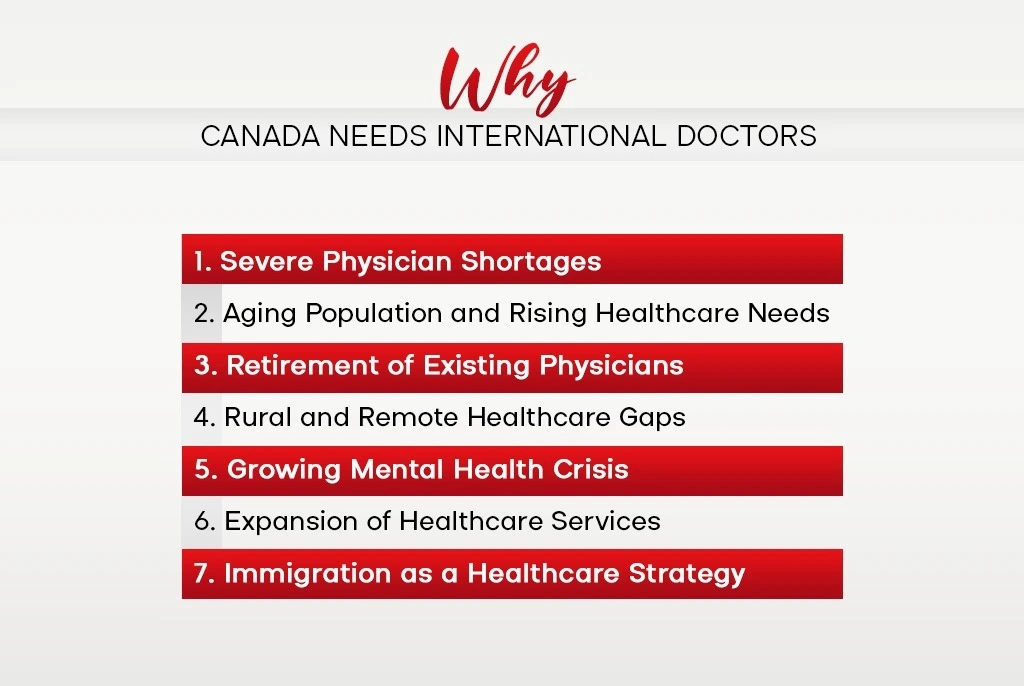
Why Canada Needs International Doctors
Canada increasingly relies on internationally trained physicians to sustain its healthcare system and ensure timely patient care. The demand for Doctors in Canada has outpaced the number of domestically trained graduates, making foreign doctors essential to filling critical gaps across provinces.
1. Severe Physician Shortages
Many regions face persistent shortages of family doctors and specialists. Millions of residents still lack access to a regular primary care provider, and wait times for specialist appointments can stretch for months. International doctors help reduce these gaps and improve healthcare access.
2. Aging Population and Rising Healthcare Needs
Canada’s population is aging rapidly, increasing the need for ongoing medical care, chronic disease management, and geriatric services.
Older populations typically require:
- More frequent medical visits
- Complex treatments
- Long-term care management
This demographic shift is a major driver behind the growing demand for Doctors in Canada.
3. Retirement of Existing Physicians
A significant portion of Canada’s current medical workforce is nearing retirement age. As experienced doctors leave practice, the healthcare system must replace them quickly to maintain service levels.
International medical graduates provide an immediate solution to this workforce transition.
4. Rural and Remote Healthcare Gaps
Rural and northern communities experience the most severe doctor shortages. Many Canadian-trained physicians prefer urban centers, leaving smaller towns underserved.
International doctors often fill these roles through:
- Rural recruitment programs
- Provincial nomination streams
- Incentive-based placements
Doctors willing to work in these areas may benefit from faster licensing and immigration support.
5. Growing Mental Health Crisis
The rising need for mental health services has intensified the demand for psychiatrists in Canada and other specialists. Increasing cases of anxiety, depression, substance use disorders, and youth mental health issues have stretched the system beyond capacity.
International psychiatrists and mental health professionals are therefore highly valued.
6. Expansion of Healthcare Services
Canada continues to invest in expanding hospitals, clinics, and community health programs. More facilities mean greater staffing requirements, especially for General practitioners and Family physicians in Canada, who serve as the foundation of primary care.
7. Immigration as a Healthcare Strategy
Canada uses immigration policy as a strategic tool to address workforce shortages. Targeted selection programs including healthcare-focused draws like express entry draw 397 demonstrate the country’s commitment to attracting qualified physicians from abroad.
Many provinces now offer practice-ready assessment programs to help experienced international doctors start working sooner.
Job Opportunities for Doctors in Canada
Canada offers strong and growing job opportunities for doctors, especially due to physician shortages, an aging population, and expansion of healthcare services. Opportunities for Doctors in Canada exist in multiple settings:
- Public hospitals
- Private clinics
- Community health centers
- Academic institutions
- Rural healthcare facilities
Provinces with High Demand
High-opportunity provinces include:
1. Saskatchewan
2. Newfoundland and Labrador
3. Alberta
4. Ontario
5. British Columbia
International doctors are particularly recruited in these regions.
Immigration Pathways for Doctors in Canada
Canada offers multiple immigration routes for internationally trained doctors due to the country’s ongoing physician shortage. Here are the main pathways available:
1. Express Entry (Permanent Residence)
The most popular pathway for doctors seeking permanent residency.
Programs under Express Entry:
- Federal Skilled Worker Program (FSWP)
- Canadian Experience Class (CEC)
- Federal Skilled Trades Program (less common for doctors)
Doctors qualify under healthcare occupations (NOC codes for physicians).
Benefits:
- Direct pathway to PR
- Ability to live and work anywhere in Canada
- Faster processing times
Canada has also introduced category-based draws for healthcare professionals, increasing chances for doctors.
2. Provincial Nominee Programs (PNPs)
Provinces can nominate doctors for permanent residence based on local demand.
Provinces actively recruiting doctors:
- Saskatchewan
- Alberta
- Ontario
- British Columbia
- Newfoundland and Labrador
Advantages:
- Lower CRS score requirements
- Priority processing
- Job-offer based pathways
Some provinces offer streams specifically for healthcare professionals.
3. Work Permit Pathway
Doctors can first enter Canada on a work permit and later apply for PR.
Common options:
- Employer-specific work permit
- Labour Market Impact Assessment (LMIA) based jobs
- Rural and underserved community recruitment
After gaining Canadian work experience, doctors can apply through Express Entry or PNPs.
4. Rural and Northern Immigration Pilot (RNIP)
Designed to attract skilled workers to smaller communities.
Benefits for doctors:
- Easier PR pathway
- Community support
- High demand for healthcare professionals
5. Atlantic Immigration Program (AIP)
For doctors working in Atlantic provinces:
- Newfoundland and Labrador
- Nova Scotia
- New Brunswick
- Prince Edward Island
Employer-driven PR pathway for skilled workers, including physicians.
Canada Immigration for Doctors in 2026
Canada has introduced major immigration changes in 2026 to address the nationwide doctor shortage, creating faster and clearer pathways for international medical graduates (IMGs).
Express Entry — New Physician Category (2026)
The biggest update is a dedicated Express Entry stream for doctors.
- New category: Physicians with Canadian Work Experience
- Requires at least 1 year of recent work experience in Canada as a doctor
- Targets roles like:
- General practitioners & family physicians
- Surgeons
- Clinical & laboratory specialists
- Invitations began in early 2026
This stream prioritizes doctors already working in Canada and helps them transition to permanent residency faster.
Doctors may also receive invitations through category-based draws specifically for physicians, introduced in 2026.
Doctors applying now may benefit from priority selection as Canada strengthens its healthcare workforce.
How to Become Doctor in Canada from India
Becoming a licensed doctor in Canada as an Indian medical graduate is possible, but it requires credential verification, exams, residency training, and licensing.
Here’s a clear step-by-step guide
Step 1: Verify Your Medical Degree
You must confirm that your Indian medical degree is recognized in Canada.
- Register with the Medical Council of Canada (MCC)
- Submit credentials through physiciansapply.ca
This process verifies your MBBS degree and transcripts.
Step 2: Pass Required Medical Exams
- Assesses medical knowledge and clinical decision-making
- Mandatory for most international medical graduates (IMGs)
Conducted by the Medical Council of Canada.
Some provinces may require additional exams or assessments.
Step 3: Apply for Residency in Canada
To practice independently, most IMGs must complete residency training in Canada.
Apply through Canadian Resident Matching Service (CaRMS)
Residency spots for international doctors are limited and competitive.
Step 4: Obtain Medical License
Licensing is issued by provincial medical authorities such as:
- College of Physicians and Surgeons of Ontario
- College of Physicians and Surgeons of British Columbia
- College of Physicians and Surgeons of Alberta
Requirements vary by province but typically include:
- Exams
- Residency completion
- Language proficiency (IELTS/OET)
- Proof of training
Alternative Path: Practice-Ready Assessment (PRA)
Some provinces offer PRA programs for experienced doctors.
- Allows IMGs to work under supervision
- Faster route than residency
- Available mainly in high-demand provinces
Common in:
- Saskatchewan
- Alberta
- British Columbia
Step 5: Immigration Pathway
After securing a job or license, doctors can immigrate through:
- Express Entry (Healthcare category)
- Provincial Nominee Programs
- Work Permit to PR pathway
Canada actively recruits international doctors due to shortages.
Salary of Doctors in Canada
Doctor salaries in Canada are among the highest in the world! But they vary widely by specialization, experience, province, and practice type.
| Type of Doctor | Average Annual Salary (CAD) | Salary Range (CAD) |
|---|---|---|
| General Practitioners / Family Physicians | $230,000 | $200,000 — $320,000 |
| Psychiatrists | $300,000 | $270,000 — $420,000 |
| Pediatricians | $250,000 | $210,000 — $360,000 |
| Emergency Physicians | $350,000 | $320,000 — $470,000 |
| Medical Specialists (e.g., Cardiologists, Neurologists) | $400,000 | $320,000 — $650,000+ |
| Surgeons (General) | $450,000 | $370,000 — $700,000+ |
| Neurosurgeons / Orthopedic Surgeons | $600,000+ | $500,000 — $850,000+ |
Factors Affecting Salary are :
1. Province
2. Experience level
3. Specialty
4. Practice location
5. Patient volume
Rural doctors often earn more due to incentives and grants.
Also, explore the in-demand healthcare jobs in Canada and find the best career options for skilled professionals.
Conclusion
The unprecedented demand for Doctors in Canada makes this one of the most promising times for international physicians to migrate. From high salaries and stable careers to targeted immigration programs, Canada is actively opening doors for skilled doctors worldwide.
Whether you are a family physician, specialist, or psychiatrist, opportunities exist across provinces — especially for those willing to serve in high-need communities.
Now is the time to act. Start preparing your credentials, explore licensing pathways, and position yourself for upcoming immigration draws.
If your dream is to practice medicine in Canada, begin exploring your eligibility and immigration options today with CanApprove, your future patients are waiting in Canada!



I am a pediatrician working now in KSA , YEMENI national, DOB 1965 , can I have the chance to work in Canada as a Pediatric doctor in any province , and get easily the Job-offer from any hospital ?
Hello Zaki Ali,
Thank you for contacting us.
Yes, it is possible for internationally trained doctors, including pediatricians, to work in Canada. However, physicians in Canada must meet certain requirements before they can practice. This usually includes credential verification, medical exams, and licensing from the provincial medical authority.
Since you are a pediatrician currently working in KSA and a Yemeni national (DOB: 1965), your eligibility will depend on factors such as your medical qualifications, years of experience, and licensing pathway in Canada.
In most cases, doctors need to:
• Verify their medical degree through the appropriate authorities
• Pass required medical licensing exams
• Apply for provincial medical registration or residency pathways
Getting a direct job offer from a hospital is not usually easy without completing these licensing steps, but there may be alternative pathways or programs depending on your profile.