




Germany’s healthcare system is actively seeking skilled professionals to meet growing demand, and this has created excellent opportunities in pharmacist jobs in Germany for foreigners. With an aging population, expanding pharmacy services, and a shortage of qualified pharmacists in Germany, Germany has opened clear pathways for internationally trained professionals.
For foreign pharmacists, this demand translates into stable careers, structured licensing processes, and long-term prospects within one of Europe’s strongest healthcare systems.
Table Of Content
1Are Pharmacists in demand in Germany?2Pharmacists in Germany Requirements3Approbation Exam for Pharmacist in Germany4How to become Pharmacist in Germany from India5Pharmacist Jobs in Germany5Pharmacist Salary in Germany5Conclusion6Frequently Asked Questions
Are Pharmacists in demand in Germany?
Yes, pharmacists are in demand in Germany.
There is a shortage of qualified pharmacists, especially in community pharmacies, and many positions remain open for months due to retirement and fewer new graduates. This creates opportunities for both local and internationally-trained pharmacists, provided foreign qualifications are recognised.
Germany’s healthcare system needs skilled pharmacists in community, hospital, and industry roles, and authorities often view pharmacy as a skill-shortage profession, easing work-permit processes for qualified applicants.
Pharmacists in Germany Requirements
To work in Germany, pharmacists need a recognised pharmacy degree (non-EU degrees may require an equivalence check or exam), Approbation (licence), B2–C1 German proficiency, a valid work/residence permit, medical fitness, a clean criminal record, and all certified documents submitted to the state authority.
Here are the updated pharmacist requirements in germany to work as a pharmacist there, with a clear point for foreigners:
Recognised Pharmacy Qualification – Your pharmacy degree must be officially recognised in Germany. Non-EU qualifications usually require an equivalence check and, in some cases, a knowledge exam.
Approbation (Licence) – You must obtain the German licence to practise as a pharmacist.
German Language Proficiency – Typically B2 level German, with professional/pharmaceutical German often at C1.
As a Foreigner – You must hold a valid residence permit or work visa (EU Blue Card, Work Visa, or Recognition Visa) allowing you to work in Germany.
Health and Character Proof – Good medical health and a clear criminal background.
Complete Documentation – Certified and translated educational and personal documents submitted to the relevant state authority.
Approbation Exam for Pharmacist in Germany
The Kenntnisprüfung, or knowledge examination, is the Approbation exam required for foreign-trained pharmacists in Germany when their qualifications reveal substantial differences from the German 5-year pharmacy training leading to the Staatsexamen. Conducted by the state licensing authority (Approbationsbehörde), it is an oral-practical test lasting 60-90 minutes with three examiners, focusing on real-world scenarios like drug therapy decisions and patient counseling.
Key topics mirror Germany’s state exam, including pharmacology, pharmaceutics, clinical pharmacy, toxicology, prescription validation, and pharmacy-specific laws such as the Apothekengesetz. Candidates face case-based questions testing analytical skills, such as recommending therapies or identifying drug interactions, with no written component.
Prerequisites include B2 general German certification and passing the C1 Fachsprachprüfung beforehand; preparation involves 3-6 month courses, mock exams, and aligned textbooks, with one retake typically allowed and fees of €400-900. Success grants full Approbation for independent practice.
How to become Pharmacist in Germany from India
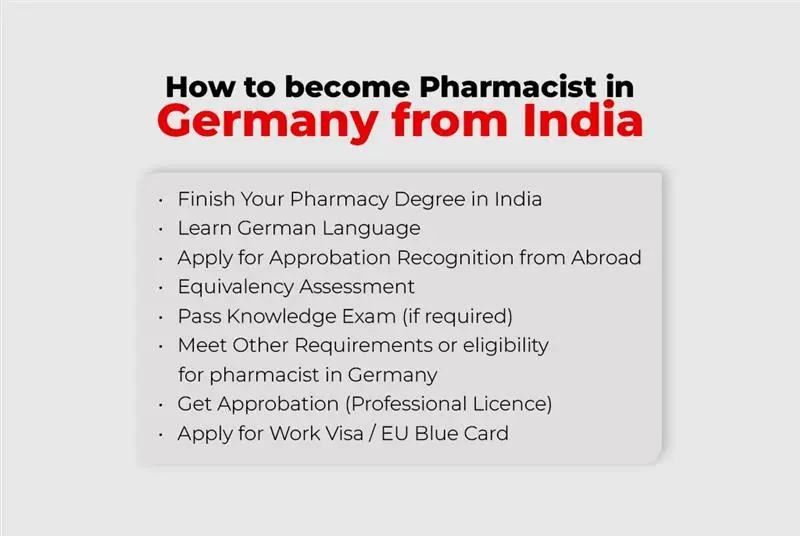
Here’s the step-by-step process to become licensed pharmacists in Germany from India:
1. Finish Your Pharmacy Degree in India
Complete your B.Pharm, M.Pharm or Pharm.D from a recognized Indian university.
2. Learn German Language
Achieve B2 level German (minimum) and then pass a professional pharmaceutical German test (Fachsprachenprüfung, C1) — required for safe professional work.
3. Apply for Approbation Recognition from Abroad
Submit an approbation for pharmacist in Germany application to the competent German state authority (e.g., a State Health Office). They will check if your Indian qualification is equivalent to the German pharmacy training.
4. Equivalency Assessment
Authorities compare your education with German standards:
- If no significant differences are found → your degree is recognised.
- If differences are found → you may need to pass a Knowledge Examination (Kenntnisprüfung).
5. Pass Knowledge Exam (if required)
This exam tests pharmacy knowledge similar to the German final pharmacy exam and is conducted in German. Passing it proves your qualification is at German standard.
6. Meet Other Requirements or eligibility for pharmacist in Germany
You must also show:
- Good health and character
- German translations of all documents
- Certified copies of certificates.
7. Get Approbation (Professional Licence)
Once your qualification is recognised and language + other conditions are fulfilled, you receive Approbation, allowing independent practice anywhere in Germany.
8. Apply for Work Visa / EU Blue Card
After licence approval and job offer from a German pharmacy, apply for a Work Visa or EU Blue Card to live and work in Germany. The specific visa depends on salary and contract terms.
Pharmacist Jobs in Germany
The Pharmacist Jobs in Germany are:
1. Apotheker / Community Pharmacist
2. Hospital Pharmacist (Krankenhausapotheker)
3. Clinical Pharmacist (Klinischer Apothekerin)
4. Industrial Pharmacist (Industrieapotheker)
5. Regulatory Affairs Pharmacist
6. Assurance Pharmacist
7. Quality Control Pharmacist
8. Pharmacovigilance Pharmacist
9. Drug Information Pharmacist
10. Research Pharmacist
Pharmacists play a vital role in ensuring the safe and effective use of medicines, and they come under In Demand Jobs in Germany. They dispense and prepare medications, provide expert guidance to patients and healthcare professionals, and monitor drug safety. They also ensure compliance with healthcare laws, quality standards, and ethical practices.
Pharmacist Salary in Germany
The pharmacist salary in Germany is around €56,100 per year, reflecting strong earning potential across experience levels and making the profession attractive for both local and international professionals.
Let’s look at the salary details based on experience level:
Entry-level pharmacists in Germany typically earn around €28,900 to €45,000 annually (gross), with 0–2 years of experience post-Approbation. They often start in community pharmacies or hospitals under supervision. This equates to €2,400–€3,750 per month before taxes.
Mid-level pharmacists in Germany typically earn around €57,000–€65,000 per year, with 5–10 years of experience, as salaries rise due to expertise in clinical roles or management positions. Monthly gross pay reaches €4,750–€5,400. Additional perks such as performance bonuses and pension contributions enhance total compensation.
Experienced pharmacists in Germany typically earn around €70,000–€88,000 annually with 15+ years of experience, and up to €80,520+ for senior professionals with 20+ years in leadership or industry roles. Top earners in private pharmacies or pharmaceutical companies can earn €7,300+ per month (gross). The nationwide median salary stands at €56,100, with variations driven by factors such as location, public-sector pay scales, and ABDA negotiations.
Conclusion
In conclusion, the rising demand for pharmacists in Germany highlights the country’s urgent need for qualified healthcare professionals. Through well-defined Germany immigration pathways, international pharmacists can access rewarding and long-term career opportunities.
With strong prospects, structured licensing, and workforce shortages, Healthcare Jobs in Germany continue to offer stability, growth, and global professional recognition.