



Green jobs are shaping the future of work, and Germany is leading the way. In 2026, sustainability-focused careers are opening doors across renewable energy, environmental technology, green construction, and climate innovation. But what do these roles actually pay? How can international professionals secure Green jobs in Germany ? And what responsibilities come with these in-demand positions?
This blog breaks it all down: salary insights, pathways to enter the field, and real-world job responsibilities. Let’s dive in.
Table Of Content
1What are Green Jobs in Germany?2Green Jobs in Germany for Foreigners3How to get Green Jobs in Germany4Conclusion5Frequently Asked Questions
What are Green Jobs in Germany?
Green jobs in Germany refer to professions that actively contribute to environmental protection, climate action, and sustainable economic growth. Driven by Germany’s ambitious energy transition and its goal of achieving greenhouse gas neutrality by 2045, these jobs span across sectors such as renewable energy, transport, construction, agriculture, and manufacturing.
Green jobs focus on reducing carbon emissions, improving energy efficiency, and developing eco-friendly technologies, making them future-oriented careers with long-term stability.
Thanks to the rapid expansion of renewable energy and green technologies, Germany has created strong demand for skilled professionals in areas like engineering, IT, environmental sciences, and technical trades.
From wind and solar power to electric mobility and sustainable construction, green jobs form the backbone of Germany’s sustainable economy.
With hundreds of thousands already employed in this sector and continued growth expected, green jobs offer international professionals the opportunity to build meaningful careers while contributing to a cleaner, more sustainable future
Green Jobs in Germany for Foreigners
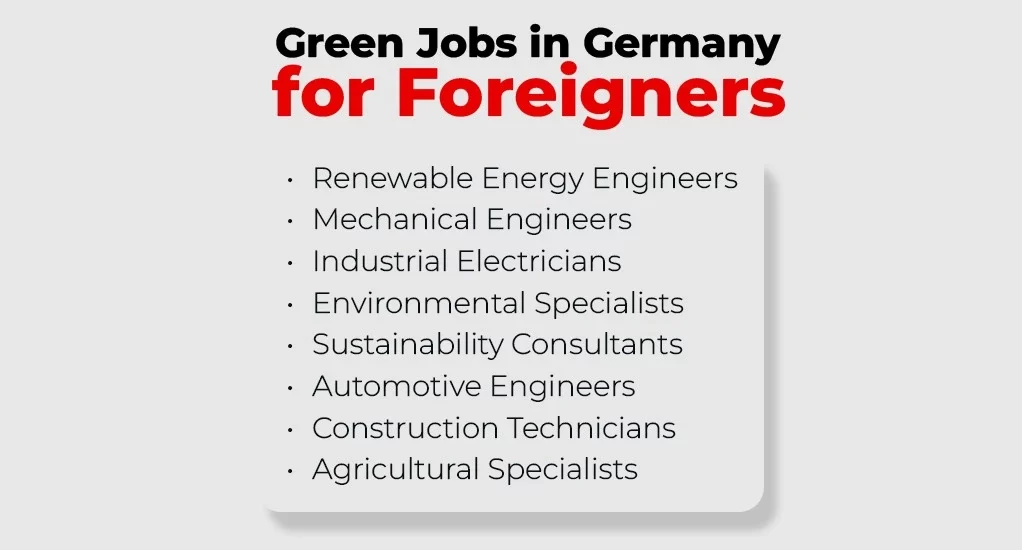
Here is the list of some of the green jobs in Germany for Foreigners:
1. Renewable Energy Engineers
2. Mechanical Engineers
3. Industrial Electricians
4. Environmental Specialists
5. Sustainability Consultants
6. Automotive Engineers
7. Construction Technicians
8. Agricultural Specialists
A detailed overview of all the job roles is given below:
1. Renewable Energy Engineers
Renewable Energy Jobs in Germany are expanding rapidly due to the Energiewende policy, aiming for 80% renewable electricity by 2030, creating high demand for engineers, specifically in areas like Wind Power, Photovoltaics, Solar Installation, skilled in wind, solar, and PV systems.
What does a Renewable Energy Engineer do?
- Design and optimize wind turbines, solar panels, and photovoltaic systems for maximum efficiency.
- Conduct site assessments and feasibility studies for renewable energy projects.
- Perform simulations and modeling for energy output predictions using software like MATLAB or PVSyst.
- Oversee installation, testing, and maintenance of renewable infrastructure.
- Ensure compliance with environmental regulations and grid integration standards.
- Collaborate with teams on project planning, budgeting, and performance analysis.
Salary for Renewable Energy Engineers in Germany
The Average Salary for Renewable Energy Engineers in Germany ranges between €50,000 to €70,000 per year.
- Entry-Level: €38,000 – €50,000 per year
- Mid-Level: €50,000 – €60,000 per year
- Experienced/Senior-Level: €65,000+ per year
2. Mechanical Engineers
Mechanical Engineers demand surges from Germany’s green manufacturing push, with factories adapting to low-emission processes under EU sustainability mandates. And thus, in Sustainable Manufacturing and Green Tech, the demand is increasing.
What does a Mechanical Engineer do?
- Develop machinery for eco-friendly production lines in green tech firms.
- Design energy-efficient components for sustainable manufacturing equipment.
- Test prototypes for durability, efficiency, and environmental impact.
- Optimize processes to reduce waste and energy consumption.
- Integrate automation systems for renewable material handling.
- Support R&D for circular economy innovations like recycling tech.
Salary for Mechanical Engineers in Germany
The Average Salary for Mechanical Engineers in Germany ranges between €55,000 to €75,000 per year.
- Entry-Level: €45,000 – €55,000 per year
- Mid-Level: €55,000 – €65,000 per year
- Experienced/Senior-Level: €70,000+ per year
3. Industrial Electricians
With the shift toward e-mobility and grid electrification, skilled industrial electricians are in short supply. This transition is driving demand, with 350,000+ green jobs expected by 2030.
What does an Industrial Electrician do?
- Install and maintain electrical systems for EV charging stations and factories.
- Wire control panels for renewable energy integration.
- Troubleshoot and repair electrification equipment in industrial settings.
- Upgrade legacy systems to smart, energy-efficient grids.
- Conduct safety inspections on high-voltage installations.
- Assemble components for battery storage and power distribution.
Salary for Industrial Electricians in Germany
The Average Salary for Industrial Electricians in Germany ranges between €40,000 to €55,000 per year.
- Entry-Level: €35,000 – €42,000 per year
- Mid-Level: €42,000 – €50,000 per year
- Experienced/Senior-Level: €55,000+ per year
4. Environmental Specialists
Germany’s climate neutrality goal by 2045 is driving demand for environmental specialists, especially in biodiversity and waste management, making them among the in-demand jobs in Germany within the rapidly expanding green jobs sector.
What does an Environmental Specialist do?
- Assess project impacts on biodiversity and ecosystems.
- Develop waste reduction strategies for industrial operations.
- Monitor air, water, and soil quality at green sites.
- Prepare environmental reports for regulatory approvals.
- Implement remediation plans for contaminated areas.
- Advise on sustainable practices for compliance.
Salary for Environmental Specialists in Germany
The Average Salary for Environmental Specialists in Germany ranges between €50,000 to €65,000 per year.
- Entry-Level: €45,000 – €52,000 per year
- Mid-Level: €52,000 – €60,000 per year
- Experienced/Senior-Level: €65,000+ per year
5. Sustainability Consultants
Rising ESG regulations are fueling demand, with firms seeking sustainability consultants who have the expertise to support net-zero transitions, including roles focused on carbon footprint management and energy efficiency.
What does a Sustainability Consultant do?
- Analyze carbon footprints and recommend reduction measures.
- Audit energy use in buildings and operations.
- Develop sustainability strategies and action plans.
- Train staff on green practices and compliance.
- Report on ESG metrics for stakeholders.
- Benchmark performance against industry standards.
Salary for Sustainability Consultants in Germany
The Average Salary for Sustainability Consultants in Germany ranges between €55,000 to €75,000 per year.
- Entry-Level: €48,000 – €55,000 per year
- Mid-Level: €55,000 – €65,000 per year
- Experienced/Senior-Level: €70,000+ per year
6. Automotive Engineers
E-mobility targets aiming for 15 million EVs by 2030 are driving strong demand for automotive engineers, especially EV and e-mobility specialists.
What does an Automotive Engineer do?
- Design EV components like batteries and motors.
- Develop charging infrastructure systems.
- Test vehicle prototypes for efficiency and safety.
- Optimize aerodynamics for reduced emissions.
- Integrate software for autonomous green features.
- Collaborate on supply chain sustainability.
Salary for Automotive Engineers in Germany
The Average Salary for Automotive Engineers in Germany ranges between €60,000 to €80,000 per year.
- Entry-Level: €50,000 – €60,000 per year
- Mid-Level: €60,000 – €70,000 per year
- Experienced/Senior-Level: €75,000+ per year
7. Construction Technicians
Construction Technicians (Green Buildings & Energy-Efficient Installations) are among the most in-demand green jobs in Germany. With a nationwide renovation wave underway, Germany aims to upgrade nearly 2 million homes every year to meet energy-efficiency standards, creating massive demand for skilled professionals in sustainable construction and energy-efficient building technologies.
What does a Construction Technician do?
- Install insulation and HVAC for passive houses.
- Assemble solar-integrated building systems.
- Retrofit structures for zero-energy standards.
- Test energy performance of new constructions.
- Maintain green certification documentation.
- Supervise on-site sustainable material use.
Salary for Construction Technicians in Germany
The Average Salary for Construction Technicians in Germany ranges between €40,000 to €55,000 per year.
- Entry-Level: €35,000 – €42,000 per year
- Mid-Level: €42,000 – €50,000 per year
- Experienced/Senior-Level: €55,000+ per year
8. Agricultural Specialists
Germany’s push to expand organic farming to 30% by 2030 is significantly increasing demand for agricultural specialists
(Sustainable Farming, Horticulture), making this role one of the fastest-growing green jobs in Germany focused on
sustainable farming, organic cultivation, and eco-friendly food production.
What does an Agricultural Specialist do?
- Implement precision farming with low-impact technology.
- Manage organic crop rotation and improve soil health.
- Develop irrigation systems for water efficiency.
- Advise on agroforestry and biodiversity conservation.
- Monitor pest control using chemical-free methods.
- Optimize crop yields through sustainable practices.
Salary for Agricultural Specialists in Germany
The Average Salary for Agricultural Specialists in Germany ranges between €45,000 to €60,000 per year.
- Entry-Level: €40,000 – €48,000 per year
- Mid-Level: €48,000 – €55,000 per year
- Experienced / Senior-Level: €60,000+ per year
How to get Green Jobs in Germany
Germany’s green job market thrives in renewables and sustainability, with visas for skilled foreigners.
Here’s a concise, step-by-step guide for non-EU professionals to get green jobs in Germany:
1. Check Qualifications: Use Anabin or Recognition Finder for degree equivalence; get German B1 language skills.
2. Job Hunt: Apply via Make it in Germany, StepStone, LinkedIn; target firms like Nordex, RWE.
3. Get Offer: Secure qualified green role (e.g., solar engineer); employer aids BA approval.
4. Visa: Apply for Skilled Worker Visa (offer needed) or Germany Opportunity Card/Jobseeker (6 months search) at embassy.
5. Arrive/Register: Enter, register residence at Ausländerbehörde, start work.
Conclusion
Germany’s green revolution is a gateway to a thriving career for those ready to shape a sustainable future. From renewable energy engineers to eco-conscious urban planners, green jobs in Germany offer opportunities to make a real impact on the planet. As Germany leads in sustainability, 2026 is the perfect time to explore roles where purpose meets growth.
For professionals and graduates planning Germany immigration, the green sector offers stability, innovation, and the satisfaction of contributing to a cleaner world. Explore opportunities on Make it in Germany.