



Are you someone planning to become an optometrist in Canada from India?
Then great choice!
Canada is one of the best destinations for healthcare professionals seeking global career growth, high salaries, and permanent residency opportunities. For Indian optometrists, Canada offers excellent prospects due to its growing demand for eye care services, aging population, and well-structured healthcare system.
If you are an optometrist in India planning to move abroad, this comprehensive guide explains everything you need to know, from eligibility and licensing to salary, demand, and immigration pathways.
Table Of Content
1Are optometrists in demand in Canada?2Why Canada Needs Optometrists3Optometrist Salary in Canada (2026)4Educational Requirements to Become an Optometrist in Canada5How Indian Optometrists Can Work in Canada6Licensing Process to Practice Optometry in Canada7Immigration Pathways for Indian Optometrists7How to Start Your Journey from India8Frequently Asked Questions
Are optometrists in demand in Canada?
Yes, optometrists are in strong demand across Canada, and this need is expected to continue for many years. According to the Government of Canada’s Job Bank, the country is projected to face a significant labour shortage of optometrists between 2024 and 2033.
Why Canada Needs Optometrists
Vision care is an essential part of Canada’s healthcare system. With increasing screen usage, lifestyle diseases, and a rapidly aging population, the demand for eye care professionals continues to rise.
Key reasons for strong demand:
- Aging population requiring regular eye care
- Rising cases of diabetes-related eye diseases
- Increased awareness of preventive eye health
- Shortage of healthcare professionals in rural areas
Provinces such as Ontario, British Columbia, and Alberta consistently report demand for optometrists, especially outside major cities.
Optometrist Salary in Canada (2026)
The average salary of an optometrist in Canada is, entry-level optometrists typically earn CAD 90,000–120,000 per year, while mid-career professionals make around CAD 120,000–180,000 annually. Experienced optometrists and private practice owners can earn CAD 200,000 or more, depending on location, patient volume, and clinic ownership. Optometry is one of the highest-paid healthcare professions in Canada, offering strong earning potential and long-term career stability.
Income varies based on experience, province, patient demand, and whether you own a clinic.
Salary by Province (Approximate)
| Province | Average Salary |
|---|---|
| Ontario | CAD 140K – 220K |
| Alberta | CAD 150K – 240K |
| British Columbia | CAD 130K – 210K |
| Saskatchewan | CAD 140K – 230K |
| Manitoba | CAD 135K – 210K |
| Nova Scotia | CAD 120K – 200K |
| New Brunswick | CAD 120K – 195K |
| Newfoundland & Labrador | CAD 130K – 210K |
| Prince Edward Island | CAD 115K – 190K |
Rural and remote areas often offer higher salaries, relocation bonuses, and incentives due to shortages of eye-care professionals.
Educational Requirements to Become an Optometrist in Canada
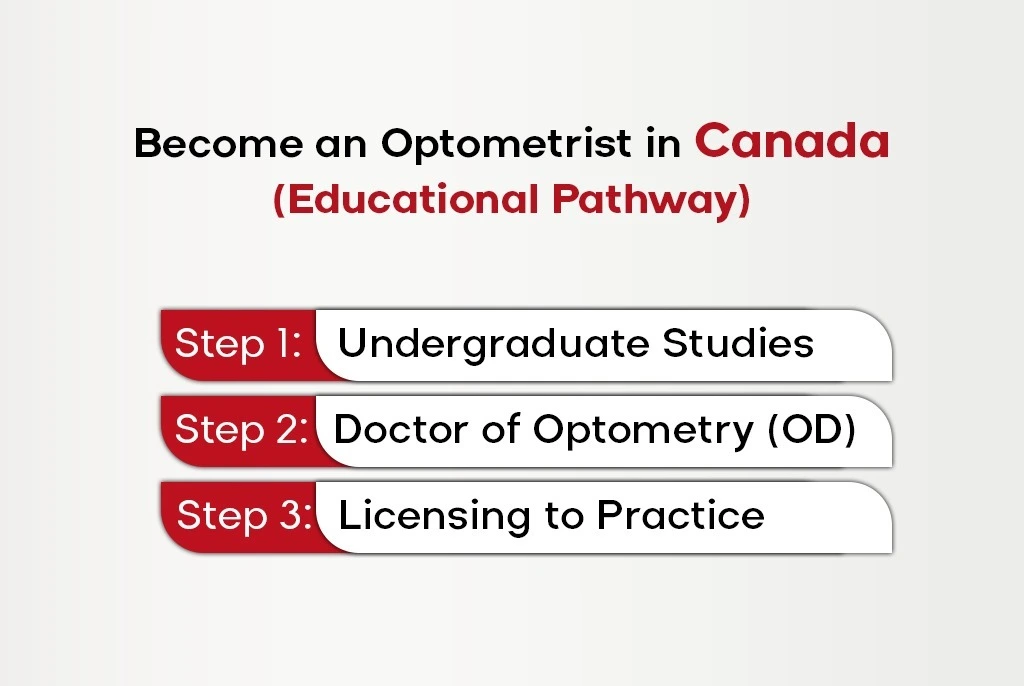
Becoming an optometrist in Canada requires completing specific academic training and licensing steps. Here’s a clear overview of the pathway:
Undergraduate Education
Before applying to optometry school, you must complete at least 2–3 years of undergraduate university education, although most successful applicants hold a 4-year bachelor’s degree.
Common prerequisite courses include:
- Biology
- General and organic chemistry
- Physics
- Mathematics or statistics
- English
- Biochemistry (often required)
Prerequisites may vary slightly by institution, so always check the exact requirements of your chosen program.
Optometry School
Canada has only two optometry schools:
- University of Waterloo School of Optometry and Vision Science
- Université de Montréal École d’optométrie
The Doctor of Optometry (OD) is a 4-year professional degree program.
Admission is highly competitive and typically considers:
- Undergraduate GPA
- Optometry Admission Test (OAT) scores
- Supplementary applications
- Interview performance
Licensing Requirements
After earning your OD degree, you must obtain a license to practice.
Requirements usually include:
- Written examinations
- Clinical/practical examinations
- Jurisprudence exam (laws and regulations)
Licensing is handled by provincial regulatory colleges, such as the College of Optometrists of Ontario and the College of Optometrists of British Columbia.
Timeline
The full journey typically takes 7–8 years:
- 3–4 years undergraduate studies
- 4 years Doctor of Optometry program
Additional time may be required for licensing exams or residency training.
How Indian Optometrists Can Work in Canada
Indian optometrists who wish to practice in Canada must complete a credential assessment and licensing process, as educational and professional standards differ between the two countries.
1. Educational Differences
In Canada, optometrists typically complete three years of undergraduate science education followed by a four-year Doctor of Optometry (OD) degree. In contrast, India offers a Bachelor of Optometry directly after Grade 12. Because of this difference, internationally trained optometrists must undergo credential evaluation.
Since 2021, assessments also emphasize training in ocular health, disease management, and therapeutics, which may affect applicants from countries where optometrists cannot independently prescribe medications.
2. FORAC Credential Assessment
The Federation of Optometric Regulatory Authorities of Canada (FORAC) evaluates the qualifications of optometrists educated outside North America. Applicants must obtain a World Education Services (WES) ICAP evaluation (about $245 CAD) and pay the FORAC credential assessment fee of $2,655.50 CAD. English proficiency proof may also be required.
3. IGOEE Examination
Once credentials are approved, candidates must take the Internationally Graduated Optometrist Evaluating Examination (IGOEE) conducted by the Touchstone Institute in Toronto. The exam costs around $5,000 CAD per attempt and assesses clinical knowledge and optometry practice standards.
4. Post-IGOEE Pathways
Based on IGOEE scores, candidates may either proceed directly to the licensing exam or enroll in the Advanced Standing Optometry Preparatory Program (ASOPP) at the University of Waterloo, which admits only a limited number of internationally trained optometrists each year.
5. National Licensing Exam
Candidates must pass the Canadian Assessment of Competence in Optometry (CACO) conducted by the Optometry Examining Board of Canada (OEBC).
6. Provincial Registration
Finally, optometrists must register with the provincial regulatory body, which may require a jurisprudence exam, background check, proof of work authorization, liability insurance, and a letter of good standing.
The pathway is challenging but achievable with proper preparation and understanding of the requirements.
Licensing Process to Practice Optometry in Canada
The licensing process for optometrists in Canada ensures that all professionals meet national standards for safe and effective eye care. Both Canadian-trained and internationally trained optometrists must complete education, examinations, and provincial registration before practicing.
Key Steps for Canadian-Trained Optometrists
| Step | Requirement | Details |
|---|---|---|
| 1. Education | Doctor of Optometry Degree | Complete 3 years of undergraduate science studies followed by a 4–5 year OD program at the University of Waterloo in Ontario. |
| 2. National Exam | Canadian Assessment of Competence in Optometry (CACO) | Conducted by the Optometry Examining Board of Canada. Includes a written test and a practical OSCE exam that evaluates clinical and patient-care skills. |
| 3. Provincial Registration | License from Provincial Regulatory Body | Requirements may include a jurisprudence exam, criminal background check, proof of work authorization, professional liability insurance, and a letter of good standing. |
Additional Steps for Internationally Trained Optometrists
| Step | Requirement | Details |
|---|---|---|
| 1. Credential Assessment | Qualification Evaluation | The Federation of Optometric Regulatory Authorities of Canada assesses international optometry credentials. |
| 2. IGOEE Exam | Skills Evaluation | Candidates must pass the Internationally Graduated Optometrist Evaluating Examination to demonstrate clinical knowledge and competency. |
| 3. Bridging Program (if required) | ASOPP | Some candidates may need to complete the Advanced Standing Optometry Preparatory Program at the University of Waterloo before taking the national exam. |
Maintaining a License
| Requirement | Details |
|---|---|
| Continuing Education | Complete regular professional development courses. |
| Annual License Renewal | Renew registration with the provincial regulator. |
| Compliance Requirements | Maintain liability insurance and periodic background checks. |
This structured process ensures that optometrists practicing in Canada meet consistent national healthcare standards.
Immigration Pathways for Indian Optometrists
Indian optometrists can immigrate to Canada through several skilled immigration programs. Here are the main pathways:
Express Entry – Federal Skilled Worker Program (FSWP)
The Federal Skilled Worker Program is a popular pathway for skilled professionals to obtain permanent residency based on factors like education, work experience, language proficiency, and CRS score.
Provincial Nominee Programs (PNPs)
Canadian provinces nominate skilled workers to meet local labour shortages. Some streams prioritize healthcare professionals. Which is a fastest route for Canada PR!
Study Pathway
International students can pursue optometry or related healthcare programs in Canada, then apply for a Post-Graduation Work Permit (PGWP) and later permanent residency.
Employer-Sponsored Work Permit
Optometrists may work in Canada if they receive a job offer from a Canadian employer, usually supported by a Labour Market Impact Assessment (LMIA).
Atlantic Immigration Program (AIP) (Limited / Niche Pathway)
Allows skilled workers with a valid job offer to settle in Atlantic provinces such as Nova Scotia, New Brunswick, Prince Edward Island, and Newfoundland and Labrador.
Note: To practice as an optometrist in Canada, candidates must complete credential evaluation through the Federation of Optometric Regulatory Authorities of Canada and pass the national exam conducted by the Optometry Examining Board of Canada.
How to Start Your Journey from India
Starting your journey to work as an optometrist in Canada begins with understanding the licensing and immigration process. Indian optometrists should first evaluate their educational credentials, complete the required assessments through the Federation of Optometric Regulatory Authorities of Canada, and prepare for the necessary licensing examinations conducted by the Optometry Examining Board of Canada.
Alongside licensing, choosing the right immigration pathway such as Express Entry or a Provincial Nominee Program is essential for successfully moving to Canada. Since the process can involve multiple steps, documentation, and careful planning, professional guidance can make a big difference. CanApprove provides expert assistance with credential evaluation, immigration pathways, and step-by-step support to help you start your career journey in Canada with confidence. Contact CanApprove today to explore your options and take the first step toward building your optometry career in Canada.