


Australia continues to be one of the most attractive destinations for healthcare professionals, and Occupational Therapists (OTs) are in high demand across states and regional areas. If you are planning to migrate to Australia as an OT, one process you simply cannot skip is the OTC Skill Assessment.
This guide explains everything you need to know about the OTC skill assessment, including eligibility, documents, fees, timelines, and common mistakes.
Table Of Content
1What Is OTC Skill Assessment?2Who Needs an OTC Skill Assessment?3OTC Skill Assessment Eligibility Criteria4OTC Accreditation Standards5Occupational Therapist Skill Assessment Australia – Documents Required6Step-by-Step OTC Skill Assessment Process7OTC Skill Assessment Fees8Tips to Improve Your OTC Skill Assessment Outcome9Frequently Asked Questions
What Is OTC Skill Assessment?
The OTC Skill Assessment is the official skills assessment test for Occupational Therapists who want to work or migrate to Australia.
OTC stands for Occupational Therapy Council (Australia)—the authorised assessing body that evaluates whether your education and professional background meet Australian occupational therapy standards.
A positive OTC skill assessment confirms that:
- Your qualification is equivalent to Australian OT education
- Your training meets professional practice standards
- You are eligible to apply for Australian migration pathways
This assessment is essential for:
- Australia PR visas
- Skilled migration programs
- Employer-sponsored visas
Who Needs an OTC Skill Assessment?
You must apply for an OTC skill assessment if you are:
1. An internationally qualified Occupational Therapist
2. Planning to migrate to Australia under:
- Skilled Independent Visa (subclass 189)
- Skilled Nominated Visa (subclass 190)
- Skilled Work Regional Visa (subclass 491)
3. Seeking an employee skills assessment for employer sponsorship
4. Applying for skill recognition before AHPRA registration
If your OT qualification was obtained outside Australia, OTC assessment is mandatory.
OTC Skill Assessment Eligibility Criteria
To migrate to Australia as an Occupational Therapist, applicants must meet the eligibility requirements set by the Occupational Therapy Council (OTC). These criteria ensure your education and skills are comparable to Australian standards.
1. Recognised Occupational Therapy Qualification
- Your qualification must be WFOT-approved at the time of graduation
- It must be comparable to an Australian Bachelor’s or Graduate Entry Master’s degree
2. English Language Proficiency
You must meet English requirements through either:
- Recognised English-medium education pathways, or
- Approved English tests (IELTS, OET, PTE Academic, TOEFL iBT, or Cambridge), meeting OTC minimum scores and validity rules
3. Required Documentation
- Identity documents (passport, birth certificate, photo ID)
- Academic records (testamur, transcripts)
- English language evidence
- Name-change documents (if applicable)
4. Identity Verification
- Applicants must complete a brief video verification call conducted by OTC
Important Update: OTC no longer accepts new Stage 1 registration applications (from 27 October 2025). However, OTC skill assessments for migration remain mandatory and continue for Australian skilled migration pathways.
Meeting these eligibility criteria is the first and most crucial step toward Australian PR as an Occupational Therapist.
OTC Accreditation Standards
The Occupational Therapy Council (OTC) Accreditation Standards, effective from 1 January 2020, define the benchmark for entry-level occupational therapy education programs in Australia. These standards ensure that graduates are equipped to practise safely, ethically, and competently, in line with Australian professional and regulatory expectations.
The framework is structured around five key domains:
1. Public Safety
Public protection is the foundation of OTC accreditation. Programs must ensure students are fit to practise, adequately supervised during placements, and meet prerequisite competencies before client interaction. Strong ethical standards, informed consent processes, and compliance with the Health Practitioner Regulation National Law Act 2009 are mandatory.
2. Academic Governance and Quality Assurance
Education providers must demonstrate effective academic governance, continuous quality improvement, and stakeholder engagement. This includes collaboration with the profession, employers, consumers, and health experts, while meaningfully embedding Aboriginal and Torres Strait Islander perspectives.
3. Program of Study
Accredited programs must deliver a coherent, evidence-based curriculum grounded in occupational therapy theory and practice. Programs are required to develop critical thinking, professional reasoning, cultural capability, research literacy, and interprofessional collaboration, while meeting OTBA competency standards and providing sufficient, diverse practice education experiences.
4. The Student Experience
Students must have equitable access to accurate information, transparent admission and progression processes, and appropriate academic and personal support. Programs must actively promote equity, diversity, and inclusion, with specific consideration for under-represented groups.
5. Assessment
Assessment systems must be fair, valid, and reliable, clearly linked to learning outcomes and competency standards. Graduates must demonstrate achievement of all outcomes required for safe and ethical occupational therapy practice, with assessments conducted and moderated by suitably qualified professionals.
Occupational Therapist Skill Assessment Australia – Documents Required
Submitting the correct documents is critical for a successful otc skill assessment.
Mandatory Documents
- Passport bio-data page
- Degree certificate (Bachelor’s/Master’s)
- Academic transcripts
- Course syllabus or curriculum details
- Clinical placement records
- English language test results
- Updated CV (Australian format)
- Professional registration (if applicable)
Work Experience Documents (If Available)
- Employer reference letters
- Job descriptions
- Payslips or contracts
All documents must be:
- Clear and legible
- In English (certified translations required)
- Uploaded as per OTC guidelines
Step-by-Step OTC Skill Assessment Process
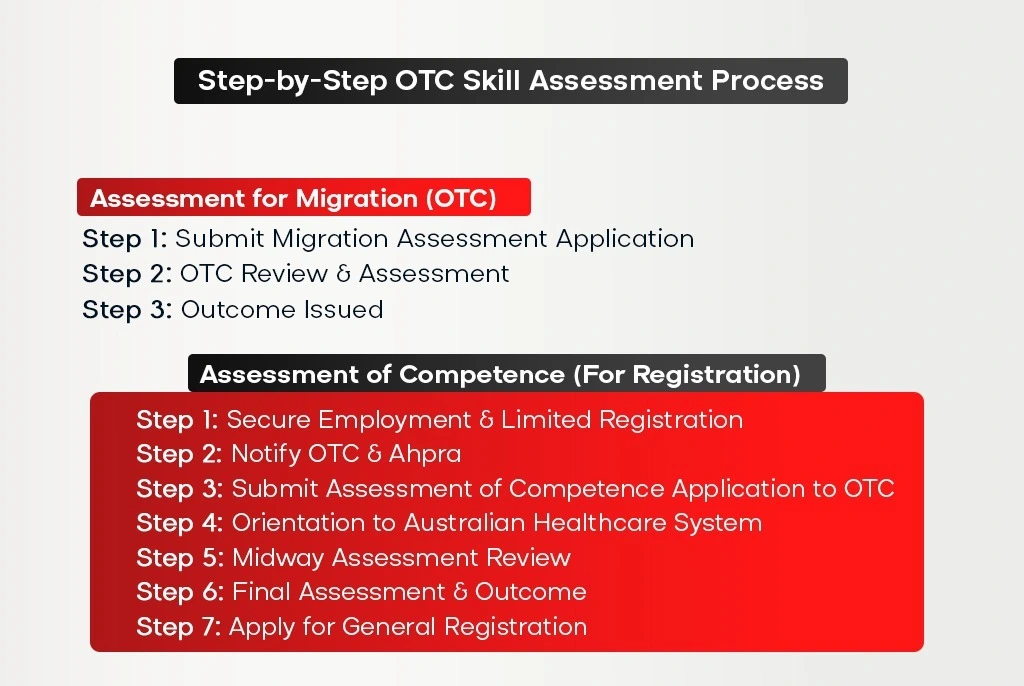
Occupational Therapists seeking Australian migration and registration must complete a two-stage process involving an Assessment for Migration and, where required, an Assessment of Competence through supervised practice.
Assessment for Migration (OTC)
Step 1: Submit Migration Assessment Application
Applicants must complete the Assessment for Migration application and submit it to the Occupational Therapy Council (OTC) along with all required supporting documents and the applicable fee via the OTC website.
Step 2: OTC Review & Assessment
OTC conducts a desktop assessment of qualifications and documentation. If additional information is needed, communication is handled via email.
Average assessment time: approximately 3 weeks, provided documents are complete.
Step 3: Outcome Issued
Upon successful assessment, OTC issues an Assessment for Migration Outcome Statement by email. This outcome is mandatory for skilled migration visa applications.
Cultural Responsiveness & Awareness Training (Mandatory)
All internationally qualified practitioners must complete cultural responsiveness and awareness training.
OTC strongly recommends completing IAHA (Indigenous Allied Health Australia) Levels 1–3, either before or alongside the competence assessment.
Failure to complete this training may result in conditions on registration imposed by the OTBA.
Assessment of Competence (For Registration)
Step 1: Secure Employment & Limited Registration
Applicants must:
- Find a suitable OT role requiring registration
- Identify an approved supervisor
- Apply for Limited Registration through Ahpra (Form ALPS-96), including employment documents and a supervised practice plan
Ahpra assesses the application on behalf of the Occupational Therapy Board of Australia (OTBA).
Step 2: Notify OTC & Ahpra
Once limited registration is granted, notify both bodies of the assessment commencement date. Supervised practice cannot begin without approved limited registration.
Step 3: Submit Assessment of Competence Application to OTC
Within two weeks of commencement, submit:
- Application form
- Position description
- Applicant & supervisor CVs
- Supervised Practice Implementation Plan (OTC format)
- Assessment fee (AUD 1,500)
OTC reviews and, if approved, issues formal confirmation with reporting timelines.
Step 4: Orientation to Australian Healthcare System
Submit the completed orientation document to Ahpra via online upload.
Step 5: Midway Assessment Review
At the midway point, submit:
- Midway progress report
- Supervision log
OTC reviews and provides feedback.
Step 6: Final Assessment & Outcome
At completion, submit the final report and any additional requested information.
If approved, OTC issues the Certificate of Competence Assessment (COCA) and notifies Ahpra.
Step 7: Apply for General Registration
Using the COCA, apply for General Registration with the OTBA via Form AGEN-96 through Ahpra.
OTC Skill Assessment Fees
The otc skill assessment fees depend on the pathway and complexity.
Approximate Fee Range
- Initial assessment: AUD 1,200 – AUD 1,500
- Additional review or reassessment: Extra charges may apply
Fees are non-refundable, even if the assessment result is negative.
Tips to Improve Your OTC Skill Assessment Outcome
- Confirm WFOT Approval Early
Ensure your occupational therapy qualification was WFOT-approved at the time of graduation. Retrospective approval is not accepted. - Match Australian Curriculum Standards
Review your syllabus carefully. Highlight core OT subjects, clinical hours, and learning outcomes that align with Australian programs. - Prepare Strong Clinical Training Evidence
Clearly document placement hours, settings, supervision details, and competencies achieved. Incomplete clinical evidence is a common reason for delays. - Meet English Requirements Confidently
Choose the right English test and aim above the minimum scores to avoid re-assessment or validity issues. - Submit Complete & Clear Documentation
Double-check uploads for accuracy, clarity, and correct naming. Missing or unclear documents often trigger information requests. - Respond Promptly to OTC Queries
If OTC requests additional information, respond quickly and precisely to keep processing on track. - Understand the Correct Assessment Pathway
Selecting the wrong pathway can delay or negatively impact your outcome—verify eligibility before applying. - Get Expert Guidance
Professional guidance can help you map your education correctly, avoid errors, and improve your chances of a positive OTC skill assessment.
Good preparation doesn’t just improve outcomes—it saves time.