




If you’re planning to immigrate to Canada and want to boost your chances of getting Permanent Residency (PR), learning French can be a major advantage. One of the most widely accepted French language exams for immigration is the TEF Canada test.
The TEF Canada exam helps Canadian immigration authorities evaluate your French language ability for programs such as Express Entry, Provincial Nominee Programs (PNP), and Canadian citizenship.
In this guide, we’ll explain everything about the TEF Canada test, including the exam format, score requirements, fees, preparation tips, and how it compares with IELTS.
Table Of Content
1What is the TEF Canada Test?2Why Is the TEF Canada Test Important for Canada Immigration?3TEF Canada Test Format and Sections4TEF Canada Score and CLB Conversion Chart5Minimum TEF Canada Test Score for Express Entry6TEF Canada Registration Process: Step-by-Step Guide7TEF Canada Test Fees in India and Other Countries8How to Prepare for the TEF Canada Test9TEF Canada vs IELTS: Which Is Better?10FAQ’s About the TEF Canada Test
What is the TEF Canada Test?
The TEF Canada test (Test d’Évaluation de Français pour le Canada) is an official French language proficiency test approved by Immigration, Refugees and Citizenship Canada (IRCC).
It measures your ability to communicate in French across four key skills:
- Reading
- Listening
- Writing
- Speaking
The test is conducted by the Chamber of Commerce and Industry of Paris (CCI Paris Île-de-France) and is widely recognized for immigration purposes.
For individuals applying for Canada PR, the French test for Canada PR can significantly improve their Express Entry CRS score.
Why Is the TEF Canada Test Important for Canada Immigration?
The TEF Canada exam plays an important role in Canadian immigration, especially for candidates applying through Express Entry.
Here are some key benefits:
- Extra CRS points for French language proficiency
- Qualification for Francophone immigration streams
- Better opportunities in French-speaking provinces like Quebec and New Brunswick
- Increased chances of getting an Invitation to Apply (ITA) for PR
Many applicants take both English and French language tests (like IELTS and TEF Canada) to maximize their immigration score. In 2026, one of the biggest Express Entry changes is the strong focus on French language proficiency, and it’s becoming a game-changer for Canada PR.
TEF Canada Test Format and Sections
The TEF Canada exam evaluates a candidate’s French language proficiency across four core communication skills. These include listening, reading, writing, and speaking. Each section is designed to test how well you can understand and use French in real-life situations.
The exam includes both receptive skills (understanding language) and productive skills (actively using the language).
1. Listening (Compréhension Orale)
The listening section tests how well you understand spoken French in everyday conversations and formal situations.
- Format: Multiple-choice questions
- Number of Questions: 60
- Duration: Around 40 minutes
You will listen to different audio clips such as conversations, announcements, and interviews. After each audio clip, you must answer related questions.
2. Reading (Compréhension Écrite)
The reading section measures your ability to understand written French.
- Format: Multiple-choice questions
- Number of Questions: 50
- Duration: Around 60 minutes
You will read texts such as advertisements, emails, articles, and instructions, and answer questions based on them.
3. Writing (Expression Écrite)
The writing section evaluates your ability to communicate ideas clearly in French through written responses.
- A short informal message, such as a note or text
- A medium-length formal message, like an email
- A longer structured piece, such as an opinion or argumentative essay
These tasks assess grammar, vocabulary, clarity, and coherence.
4. Speaking (Expression Orale)
The speaking section tests your ability to communicate verbally in French.
- A short monologue on a given topic
- A dialogue simulation with the examiner
- A point-of-view defense where you present and justify an opinion
- A situational response to a real-life scenario
Each section is scored separately and later converted to CLB levels for immigration purposes.
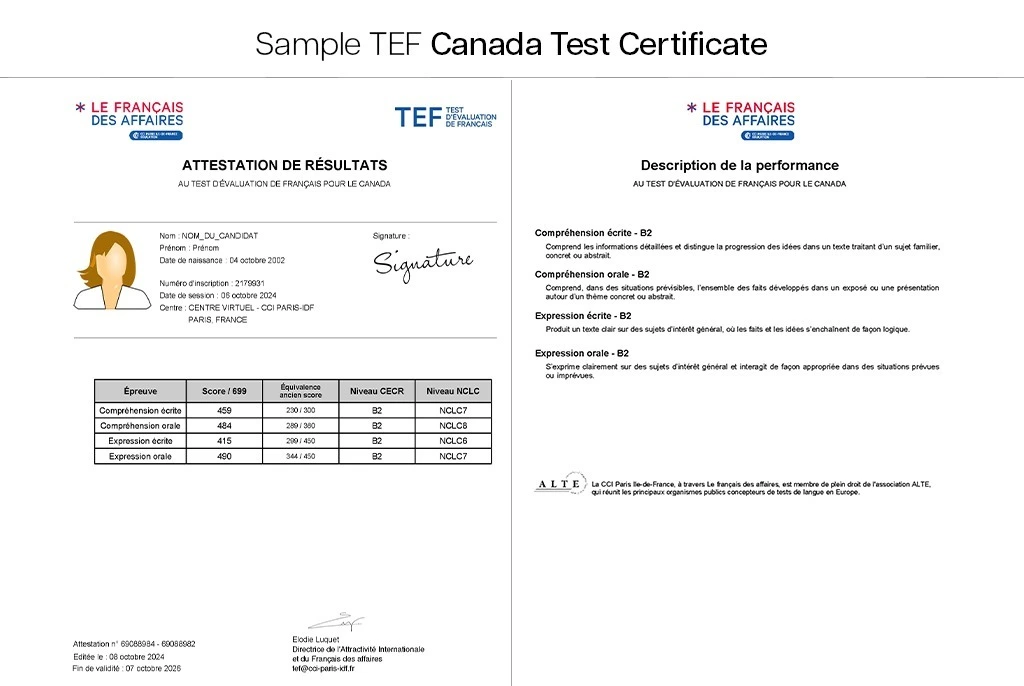
TEF Canada Score and CLB Conversion Chart
Canada uses the Canadian Language Benchmark (CLB) system to measure language ability.
Below is a simplified TEF Canada CLB conversion overview for Canadian Experience Class:
| CLB Level | Listening (360) | Reading (300) | Writing (450) | Speaking (450) | Proficiency |
|---|---|---|---|---|---|
| CLB 4 | 145–180 | 121–150 | 181–225 | 181–225 | Elementary |
| CLB 5 | 181–216 | 151–180 | 226–270 | 226–270 | Lower Intermediate |
| CLB 6 | 217–232 | 181–206 | 271–309 | 271–309 | Intermediate |
| CLB 7 | 233–248 | 207–232 | 310–348 | 310–348 | Upper Intermediate |
| CLB 8 | 249–276 | 233–262 | 349–370 | 349–370 | Pre-Advanced |
| CLB 9 | 277–298 | 263–285 | 371–392 | 371–392 | Advanced |
| CLB 10 | 299–315 | 286–298 | 393–413 | 393–413 | Superior |
| CLB 11 | 316–334 | 299+ | 414–433 | 414–433 | Near-Mastery |
| CLB 12 | 335–360 | — | 434–450 | 434–450 | Mastery |
Source: IRCC official TEF Canada score conversion tables.
Higher TEF Canada scores translate into higher CRS points in Express Entry. Also French draws are a key pathway to get Canada PR faster.
Minimum TEF Canada Test Score for Express Entry
To qualify for Express Entry, you usually need at least CLB 7 in French.
However, achieving CLB 9 or above can significantly increase your chances of receiving an Invitation to Apply (ITA).
Many applicants aim for higher scores because TEF Canada score for PR can add up to 50 additional CRS points if combined with strong English results.
TEF Canada Registration Process: Step-by-Step Guide
Follow these simple steps to complete your TEF Canada registration:
Step 1: Visit the official website of an authorized test centre such as Alliance Française.
Step 2: Check available TEF Canada exam dates and choose your preferred test location.
Step 3: Fill out the online registration form with accurate personal and identification details.
Step 4: Pay the TEF Canada test fee through the available payment methods.
Step 5: Submit your application and wait for confirmation from the test centre.
Step 6: Receive your confirmation email with exam date, venue, and test instructions.
Tip: Book your TEF Canada test early, as slots fill up quickly, especially in major cities.
TEF Canada Test Fees in India and Other Countries
The TEF Canada test fees vary depending on the country and the authorized test centre. In India, the cost typically ranges between ₹28,000 and ₹32,000, while in Europe it is around €250 to €300, and in Canada it ranges from CAD $300 to $400. Since fees may differ slightly by location and test modules, it is always recommended to check the latest pricing before booking your exam.
How to Prepare for the TEF Canada Test
Preparing effectively for the TEF Canada exam is essential to achieve a high score.
Here are some proven tips:
1. Learn French Basics
Start with grammar, vocabulary, and sentence structure.
2. Practice Listening Daily
Listen to:
- French podcasts
- News channels
- French movies or YouTube content
3. Improve Reading Skills
Read French:
- Newspapers
- Blogs
- Short articles
4. Take Mock Tests
Practice with official TEF Canada sample tests to understand the format and timing.
5. Join a French Language Course
A professional course can help you prepare faster and improve speaking confidence.
TEF Canada vs IELTS: Which Is Better?
Many applicants wonder about TEF Canada vs IELTS.
| Feature | TEF Canada | IELTS |
|---|---|---|
| Language | French | English |
| Accepted for PR | Yes | Yes |
| Difficulty | Depends on French skills | Depends on English skills |
| CRS Points | Extra points for French | Standard language points |
If you already have strong English scores, adding TEF Canada can boost your Express Entry CRS score significantly.
Some applicants also compare TEF Canada vs TCF Canada, another French exam accepted by IRCC. Both tests are valid, but TEF Canada is often more widely recognized internationally.
If you’re eager to learn more about the TCF Canada test, stay tuned to our website—we’ll be publishing a detailed guide next week.