


French language proficiency is becoming one of the fastest ways to boost your chances of Canada PR. With increasing focus on Francophone immigration, like the TCF Canada test are now a powerful tool for Express Entry candidates.
In this guide, we’ll walk you through everything you need to know from what the exam is to how to prepare and succeed.
Table Of Content
1What is the TCF Canada Test?2Why Take the TCF Canada Test for Express Entry?3Step-by-Step Guide to the TCF Canada Test4TCF Canada Scoring System5Overview of NCLC Competency Levels6TCF Canada vs TEF Canada7TCF Canada Test Fees (2026)8TCF Canada Retake & Re-evaluation Policy9FAQ’s About the TCF Canada Test
What is the TCF Canada Test?
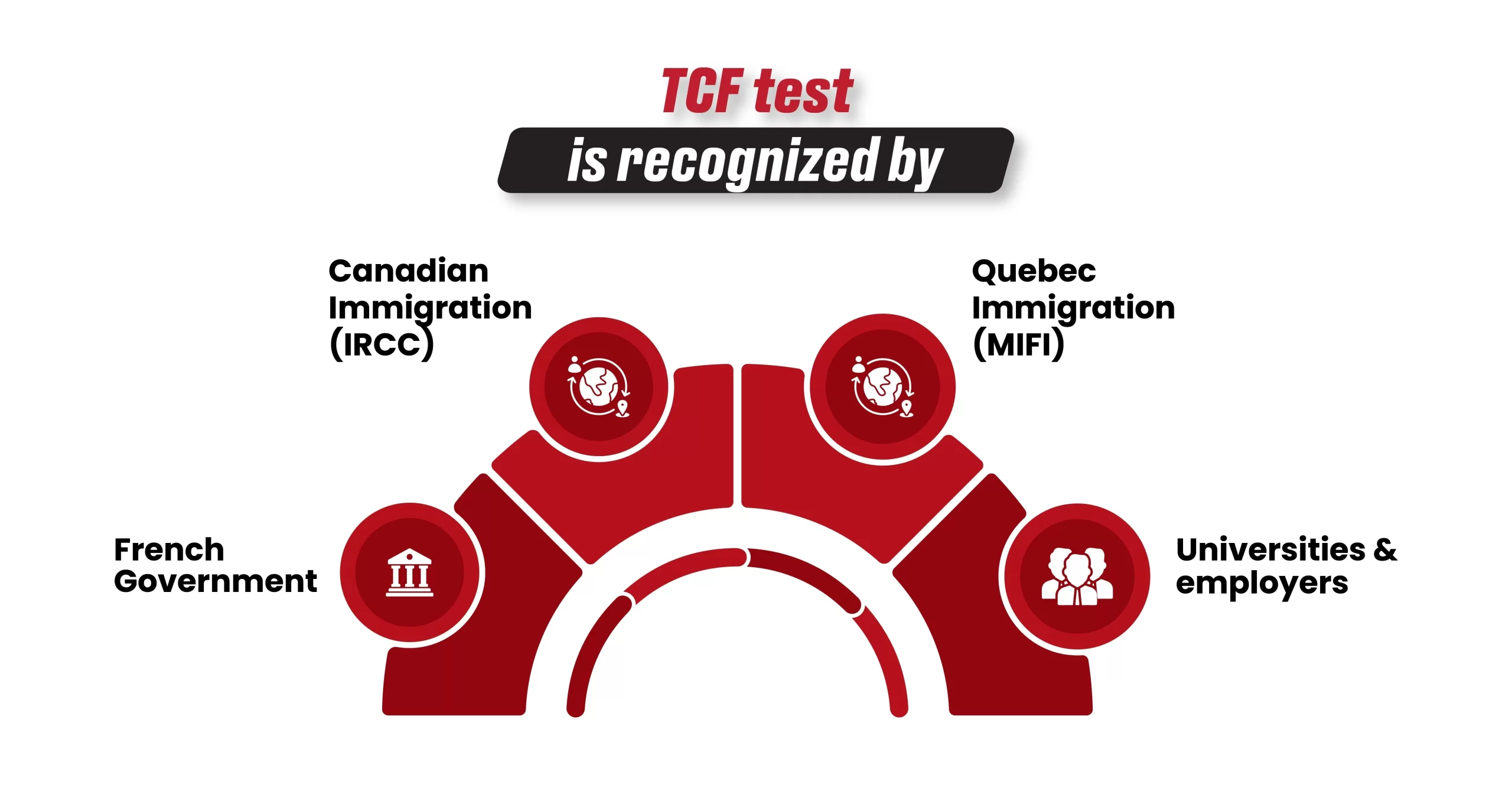
The TCF Canada (Test de connaissance du français pour le Canada) is an official French language proficiency test approved by Immigration, Refugees and Citizenship Canada for immigration purposes.
It is also recognized by the Ministry of Immigration, Francisation and Integration for those planning to immigrate to Québec.
There are 4 versions of TCF exams:
| Test Type | Purpose |
|---|---|
| TCF Tout Public | Study, work, general use |
| TCF IRN | France residency & citizenship |
| TCF Canada (TCF CA) | Canada PR & citizenship |
| TCF Quebec (TCF QC) | Quebec immigration |
Why Take the TCF Canada Test for Express Entry?
Taking the tcf canada exam can significantly improve your CRS (Comprehensive Ranking System) score. Here’s why:
- Earn additional CRS points for French proficiency
- Qualify for bilingual advantage
- Access more Provincial Nominee Program (PNP) opportunities
- Stand out among other candidates
Even basic French skills can make a huge difference in your immigration journey.
Step-by-Step Guide to the TCF Canada Test
Here’s how you can take the TCF Canada test:
Step 1: Find an Approved Test Centre
Locate a certified TCF Canada test centre near you.
Step 2: Register for the Test
- Choose your preferred date
- Complete registration
- Pay the test fee
Step 3: Prepare for the Exam
Focus on:
- Vocabulary and grammar
- Listening practice
- Speaking fluency
Step 4: Take the Test
The test includes:
- Listening (35 mins)
- Reading (60 mins)
- Writing (60 mins)
- Speaking (12 mins)
Total duration: 2 hours 47 minutes
Step 5: Receive Your Results
Results are usually available within 15 working days.
TCF Canada Scoring System
Understanding the TCF Canada scoring system is essential for anyone planning to use French language proficiency for Canadian immigration. Unlike some language tests, TCF Canada does not provide a single overall score. Instead, it evaluates your performance across four key language skills, each scored separately.
For Canadian immigration, your TCF scores are converted into the NCLC (Niveaux de compétence linguistique canadien) system. This is the official benchmark used by Immigration, Refugees and Citizenship Canada (IRCC).
NCLC 10+: Listening & Reading (549–699), Speaking & Writing (16–20)
NCLC 9: Listening (523–548), Reading (524–548), Speaking & Writing (14–15)
NCLC 7: Listening (458–502), Reading (453–498), Speaking & Writing (10–11)
NCLC 5–6: Moderate proficiency with basic communication ability.
The higher your NCLC level, the better your chances of gaining more CRS points and PR selection.
Overview of NCLC Competency Levels
Stage I – Beginner (Levels 1 to 4)
This stage describes the range of competencies required to communicate in common and predictable situations, in order to meet basic needs, carry out everyday activities, and discuss familiar topics related to one’s immediate personal environment. In NCLC, these are non-demanding contexts for language use.
Levels: NCLC 1 to NCLC 4
Listening Comprehension:
Understand simple oral messages in non-demanding and familiar contexts.
Speaking:
Produce oral messages in non-demanding and familiar contexts.
Reading Comprehension:
Understand simple written texts in non-demanding and familiar contexts.
Writing:
Write simple texts in non-demanding and familiar contexts.
Stage II – Intermediate (Levels 5 to 8)
This stage allows learners to take a more active role in a wider range of communication situations. It describes the competencies required to function independently in most everyday situations, including social life, studies, and work, as well as in less predictable contexts. In NCLC, these are moderately demanding contexts.
Levels: NCLC 5 to NCLC 8
Listening Comprehension:
Understand moderately complex oral messages in moderately demanding contexts.
Speaking:
Produce moderately complex oral messages in moderately demanding contexts.
Reading Comprehension:
Understand moderately complex written texts in moderately demanding contexts.
Writing:
Write moderately complex texts in moderately demanding contexts.
Stage III – Advanced (Levels 9 to 12)
This stage describes the competencies required to communicate effectively, appropriately, precisely, and fluently on most topics, in a variety of situations and contexts, including the most demanding ones. It involves handling complex ideas and abstract concepts with accuracy and coherence.
In NCLC, these are highly demanding contexts.
Levels: NCLC 9 to NCLC 12
Listening Comprehension:
Understand complex oral messages in demanding contexts.
Speaking:
Produce complex oral messages in demanding contexts.
Reading Comprehension:
Understand complex written texts in demanding contexts.
Writing:
Write complex texts in demanding contexts.
TCF Canada vs TEF Canada
Both TCF and TEF test are accepted for Canada immigration, but they have some differences.
| Feature | TCF Canada | TEF Canada |
|---|---|---|
| Full Name | Test de connaissance du français | Test d’évaluation de français |
| Conducted By | France Éducation International | Paris Chamber of Commerce (CCI Paris Île-de-France) |
| Test Format | MCQs + practical tasks | More structured & detailed |
| Difficulty Level | Moderate (generally considered easier) | Slightly more challenging |
| Popularity | Growing rapidly | More widely established |
| Duration | ~2 hours 47 minutes | ~2 hours 55 minutes |
| Modules | Listening, Reading, Writing, Speaking | Same 4 modules |
| Scoring | Converted to NCLC | Converted to NCLC |
If you’re looking for a slightly easier option, many candidates prefer TCF Canada.
TCF Canada Test Fees (2026)
The TCF Canada test fee in 2026 typically ranges between ₹25,000 and ₹28,000 in India, depending on the test centre. This fee covers all four mandatory modules: listening, reading, writing, and speaking. Since pricing may vary by location, candidates should check with an authorized TCF test centre for the exact cost before booking.
Validity of TCF Canada Test
The TCF Canada test results are valid for 2 years from the date they are issued. Candidates must ensure that their results are still valid at the time of submitting their application to Immigration, Refugees and Citizenship Canada. If the results expire, the test must be retaken, as older scores are not accepted for immigration purposes.
Who Should Take the TCF Canada Test?
You should consider taking the TCF Canada test if:
- You want to increase your CRS score
- You are targeting French-specific draws
- You have basic or intermediate French skills
- You want an alternative to IELTS-based scoring advantage
- You aim for faster Canada PR pathways
TCF Canada Retake & Re-evaluation Policy
Candidates must wait 30 days before retaking the test. Re-evaluation is available only for Speaking and Writing, must be requested within 1 month, and scores may either increase or decrease.