




General Practitioners (GPs) in Australia play a significant role in providing primary health care and demand for GPs remains strong, particularly in regional, rural and remote communities. Australia offers opportunities for overseas-trained doctors to build a medical career, but knowing the registration pathway, eligibility requirements and professional expectations is an important first step.
If you are thinking about working as a GP in Australia, it’s good to know what to expect before you begin the journey. Whether it’s understanding the registration pathway, or discovering where the GP opportunities are, having the right information can help you plan your next move more clearly.
Table Of Content
1Are General Practitioners in demand in Australia?2What do General Practitioners do?3Requirements to Work as a General Practitioner in Australia4FRACGP Australia5General Practitioner Jobs in Australia6General Practitioner Salary in Australia7Where are General Practitioners Most in Demand in Australia?8Conclusion9General Practitioners in Australia FAQs
Are General Practitioners in demand in Australia?
Yes, General practitioners (GPs) are in demand in Australia, especially in regional, rural and remote areas where access to GP services is lower. The Australian Government uses the Distribution Priority Area (DPA) classification to identify areas with a shortage of GP services.
The Australian Government’s workforce projections indicate an undersupply of GPs over the coming years, with demand for GP services expected to exceed available GP workforce in many communities.
Australia is increasing GP training opportunities, with around 2,100 doctors starting GP training in 2026 and more than 2,000 government-funded training places available each year.
International medical graduates (IMGs) who want to work as GPs in Australia must obtain medical registration through the appropriate Australian pathway. The pathway depends on their qualifications, training and experience, and may include the Competent Authority, Standard, or Specialist pathway.
What do General Practitioners do?
General Practitioners (GPs) provide primary healthcare by diagnosing, treating and preventing a wide range of health conditions. They also provide ongoing care and help patients access specialist services when needed.
Diagnosing Health Conditions: Assess symptoms, perform examinations and diagnose a wide range of illnesses and health problems.
Providing Treatment: Recommend appropriate treatment and prescribe medicines when required.
Managing Chronic Conditions: Provide ongoing care for long-term conditions such as diabetes and asthma.
Providing Preventive Care: Offer health advice, screening, vaccinations and other preventive healthcare services.
Referring to Specialists: Refer patients to specialists or other healthcare professionals when additional or specialised care is needed.
Coordinating Ongoing Care: Monitor patients’ health, maintain continuity of care and coordinate healthcare services when needed.
Requirements to Work as a General Practitioner in Australia
To work as a General Practitioner (GP) in Australia, overseas-trained doctors generally need an eligible medical qualification, meet the applicable English language requirements, obtain medical registration, and complete the assessment or registration pathway that applies to them.
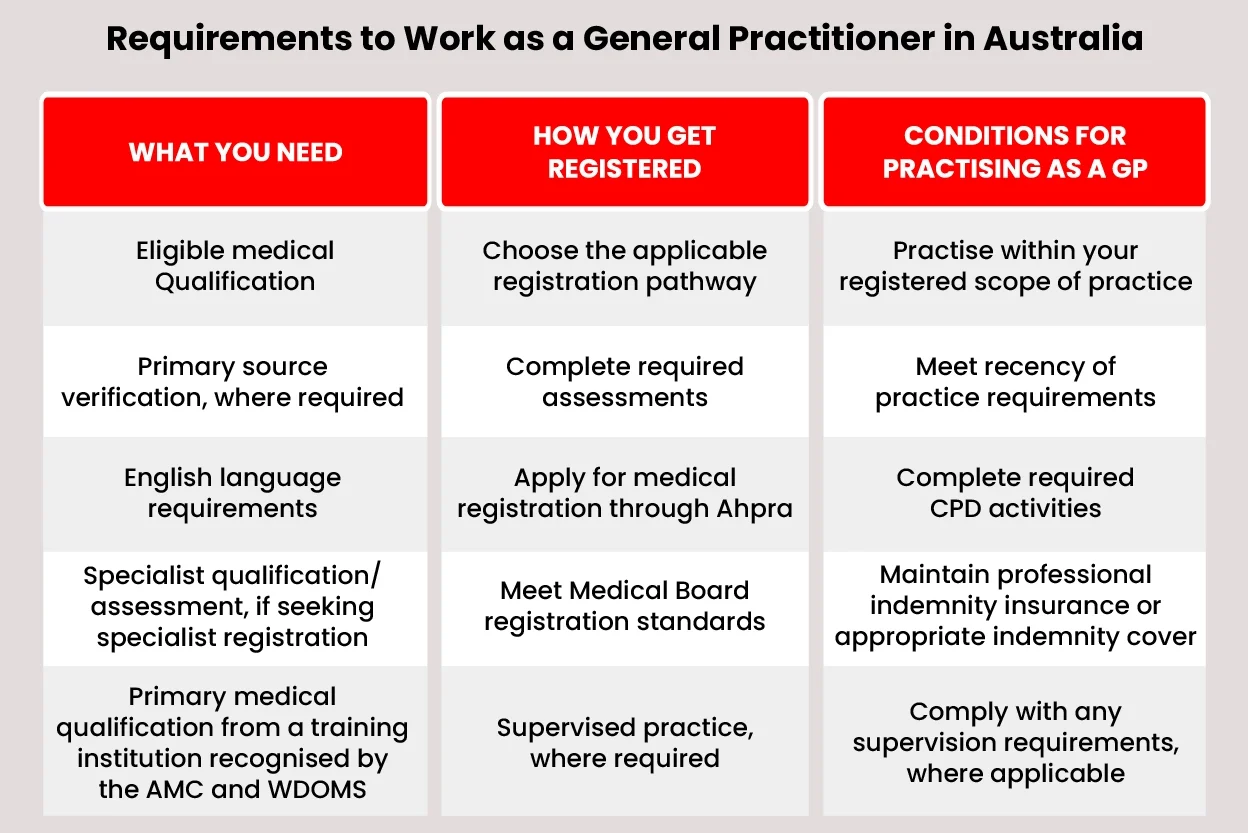
Additional requirements may apply depending on the doctor’s qualifications, experience, chosen pathway and whether they are seeking specialist recognition. For skilled migration purposes, the Australia ANZSCO Code for a General Practitioner is 253111.
1. Medical Qualification
To practice medicine in Australia you need a recognized medical qualification.
- Complete an eligible primary medical qualification in medicine and surgery, such as an MBBS, MBChB or equivalent degree.
- Graduate from a medical school and degree program that meet the eligibility requirements of the relevant Australian registration pathway.
- Have the required medical qualification verified where required.
2. Medical Qualification Assessment
International medical graduates (IMGs) might need to get their medical qualifications verified and assessed before they can proceed with registration.
- Submit the required evidence of your primary medical qualification.
- Complete the required primary source verification process.
- Establish the required AMC portfolio where applicable.
- Complete the assessment requirements of your chosen pathway.
- Under the Standard Pathway, pass the AMC CAT MCQ examination and either the AMC Clinical Examination or an AMC-accredited workplace-based assessment.
3. English Language Proficiency
Doctors applying for registration must meet the English language skills registration standard.
- Demonstrate the required level of English language proficiency.
- Meet the requirements through one of the accepted pathways under the current registration standard.
- An English language test may be required depending on how the applicant demonstrates their English proficiency
4. Medical Registration
Doctors need to be registered with the Medical Board of Australia before they can practise medicine in Australia.
- Apply for the appropriate type of registration through Ahpra.
- Meet the registration standards that apply to the chosen pathway.
- Provide the required identity, qualification and registration-history documents.
- International Medical Graduates holding limited or provisional registration must comply with the Board’s supervision requirements.
5. Supervised Practice
Some overseas-trained doctors are required to complete supervised practice as part of their registration pathway.
- Work under an approved supervision arrangement where required.
- Follow the approved supervision plan.
- Meet the Board’s requirements for supervised practice.
- Progress towards the requirements for general or specialist registration, depending on the pathway.
6. Clinical Experience
Depending on the registration or employment pathway, relevant clinical experience may be required.
- Provide evidence of previous medical practice where required.
- Meet any pathway-specific experience requirements.
- Ensure your experience is relevant to the scope of practice you intend to undertake.
- Additional experience requirements may apply to particular GP registration or area-of-need pathways.
7. GP Specialist Recognition
GP specialist recognition is not required for every doctor to obtain medical registration and practise in Australia. However, doctors who want to be recognised as a specialist GP may need to complete the relevant specialist assessment and registration pathway.
- Specialist International Medical Graduates (SIMGs) may be assessed through an applicable specialist pathway.
- Relevant specialist qualifications, training and experience may need to be assessed.
- Specialist registration is separate from general registration.
8. Professional Requirements
Registered medical practitioners must also meet ongoing professional requirements.
- Maintain appropriate professional indemnity insurance arrangements.
- Meet continuing professional development requirements.
- Meet recency-of-practice requirements.
- Practise within your approved scope of practice.
9. Medicare and GP Location Requirements
Certain overseas-trained doctors may need to work in approved locations to access Medicare benefits.
- The Australian Government uses the Distribution Priority Area (DPA) classification to identify locations with shortages of GP services.
- The Australian Government uses the Distribution Priority Area (DPA) classification to identify locations with shortages of GP services.
FRACGP Australia
FRACGP stands for Fellowship of the Royal Australian College of General Practitioners. It is the Fellowship awarded by the RACGP to doctors who have completed the necessary training, assessment and Fellowship requirements for general practice in Australia.
FRACGP indicates that a GP has met the RACGP standards for safe and high-quality general practice. It also demonstrates fitness to practise independently in Australian general practice. Doctors who have the required specialist registration can use the post-nominal ‘FRACGP’ after their name.
The requirements for FRACGP vary by pathway and may include general practice experience, education and training, workplace-based assessment, Fellowship examinations and other RACGP requirements. Overseas-trained specialist GPs entering PEP SP must first undergo a comparability assessment against an Australian-trained specialist.
General Practitioner Jobs in Australia
General Practitioner jobs in Australia can include:
General Practitioner (GP): Provides primary healthcare, including diagnosis, treatment and ongoing care.
Rural General Practitioner: Provides general practice services in regional and rural communities.
Remote Area GP: Provides healthcare services in remote and very remote Australian communities.
Locum GP: Provides temporary or relief GP services, including in rural and remote areas.
Aboriginal and Torres Strait Islander Health GP: Provides general practice services in Aboriginal Medical Services and Aboriginal Community Controlled Health Organisations.
Rural Generalist: A GP with additional training who can provide broader medical services, including hospital and emergency care in rural and remote communities.
Overseas-trained doctors can also explore jobs in Australia with visa sponsorship, depending on their qualifications, registration status, occupation and the visa pathway available to them.
General Practitioner Salary in Australia
A General Practitioner (GP) in Australia can earn approximately AUD 127,200 per year, based on the median full-time earnings of AUD 2,446 per week for the broader occupation of General Practitioners and Resident Medical Officers.
However, actual GP earnings can vary depending on experience, location, working hours, practice arrangements, and payment method. The figure is based on ABS data for May 2025 and includes both GPs and resident medical officers, so it should not be treated as a GP-only salary.
GP earnings can be higher or lower depending on factors such as:
- Experience and working hours
- Location and practice setting
- Patient volume
- Employment or practice arrangement
- Salary or percentage-of-billings arrangements
Note: GP earnings can vary significantly, so there is no single official national salary range that applies to all General Practitioners in Australia.
Where are General Practitioners Most in Demand in Australia?
Australia has a high demand for General Practitioners, particularly in Queensland, New South Wales, Western Australia, South Australia, Victoria, Tasmania and the Northern Territory. The Australian Government uses the Distribution Priority Area (DPA) classification to identify areas experiencing a shortage of GP services.
Here are the detailed areas with high demand for General Practitioners in Australia:
Queensland: Regional, rural and remote communities
New South Wales: Regional, rural and remote communities
Western Australia: Regional, rural and remote communities
South Australia: Regional, rural and remote communities
Victoria: Regional, rural and remote communities
Tasmania: Regional and rural communities
Northern Territory: Regional and remote communities
The demand for General Practitioners in Australia can vary by location, with regional, rural and remote communities often experiencing greater workforce needs.
Conclusion
A new country can mean a new chapter in your medical career, but every chapter needs a beginning. That starting point is understanding how Australian registration requirements relate to your qualifications, experience and career plans for overseas-trained GPs.
And instead of trying to navigate all at once, try to understand the pathway that applies to you and prepare for each stage ahead. For General Practitioners in Australia, understanding the right registration pathway can make this process easier to plan.
For the most up-to-date information on registration pathways and requirements for international medical graduates, visit the official Medical Board of Australia website. With the right information and preparation, your goal of practising as a GP in Australia can move from an idea to a well-planned career journey.