



Canada has quietly become one of the world’s top destinations for supply chain education, and there is a good reason for its success. With a federal government that has consistently listed logistics and supply chain roles as in-demand occupations, a booming e-commerce sector, and one of the most active port systems in North America, the country offers international students a degree that pays for itself quickly. This is a rare opportunity. This guide offers an in-depth look at supply chain management courses in Canada, including the field’s actual scope, the universities that are worth considering, the cost, and the application process.
Table Of Content
1What is Supply Chain Management?2Supply Chain Management Courses in Canada3Best Universities for Supply Chain Management in Canada4Requirements for Studying Supply Chain Management in Canada5Supply Chain Management Courses in Canada Fees6Conclusion7Frequently Asked Questions
What is Supply Chain Management?
Supply Chain Management (SCM) is the process of planning, coordinating, and controlling the flow of goods, materials, services, and information from raw material suppliers to the end customer. In simpler terms, it addresses the question, “How does a product move from the factory to the consumer’s doorstep in a cost-effective and reliable way?”
SCM encompasses more than just logistics. It includes:
Procurement and Sourcing: Selecting suppliers, negotiating contracts, and managing vendor relationships.
Inventory and Warehouse Management: Optimizing stock levels, minimizing waste, and enhancing storage efficiency.
Logistics and Transportation: Routing, carrier selection, freight management, and last-mile delivery.
Demand Planning and Forecasting: Predicting customer requirements to ensure that production and supply align.
Supply Chain Analytics: Utilizing data to inform decisions throughout the entire supply chain.
Operations Management: Optimizing internal business processes to achieve maximum throughput.
Product Distribution and Delivery Systems: Channel selection and distribution network design.
Supply chain management courses teach students how to manage these dynamic components, often using industry simulations, real-world case studies, and ERP software like SAP.
Supply Chain Management Courses in Canada
Supply Chain Management courses in Canada are offered at different levels, such as certificates, diplomas, and advanced programs, allowing students to start as beginners or upgrade their professional skills. They are among the most in-demand courses in Canada.
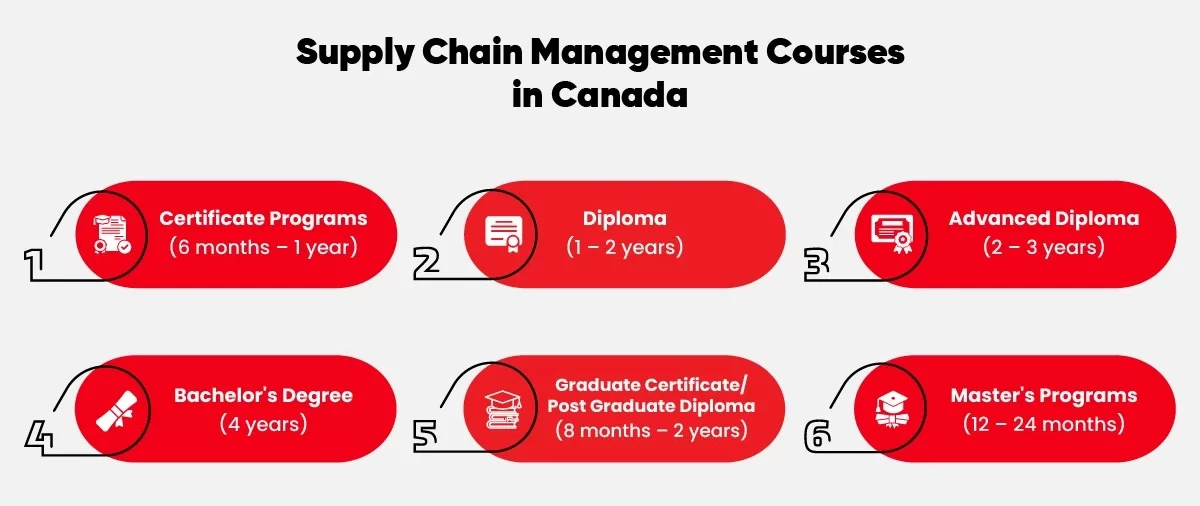
Let us go over the specifics of each level:
1. Certificate Programs in Supply Chain Management
Course Duration: 6 months to 1 year
Who Should Choose this Program
Recent graduates, working professionals, or career changers who want to rapidly gain practical supply chain skills and accelerate entry into logistics and operations roles.
Key Skills Learned in a Supply Chain Management Certificate Program
- Fundamentals of supply chain management
- Procurement and purchasing procedures
- Warehouse and inventory administration
- Logistics and transportation operations
- Supply chain technology and software
- Supplier relationship management and customer service
Job Opportunities After a Supply Chain Management Certificate
-
- Logistics Coordinator
- Inventory Assistant
- Purchasing Assistant
- Warehouse Operations Supervisor
- Supply Chain Administrator
Summary
Short, skills-focused certificates designed to quickly prepare students for entry-level roles and workplace experience.
2. Advanced Diploma & Diploma in Supply Chain Management
Course Duration: 1 to 3 years
Who Should Choose this Program
Learners seeking comprehensive training and broader career prospects in supply chain operations, with practical, industry-relevant experience. With a 1-year PG Diploma in Supply Chain Management in Canada. You are on the right path to a great future in Canada.
Key Skills Learned in a Supply Chain Management Diploma and Advanced Diploma Program
- Strategic sourcing and procurement
- Transportation and logistics management
- Inventory management and planning
- Production and operations management
- Supply chain analytics and demand forecasting
- Customs procedures and international trade
- Project management and business communication
Job Opportunities After a Supply Chain Management Diploma and Advanced Diploma
- Supply Chain Coordinator
- Procurement Officer
- Logistics Analyst
- Transportation Planner
- Operations Supervisor
- Warehouse Manager
Summary
Diplomas develop operational and supervisory skills for varied industries, preparing graduates for mid-level operational roles.
3. Bachelor’s Degree in Supply Chain Management
Course Duration: 4 years
Who Should Choose this Program
Individuals pursuing long-term career growth, more profound business knowledge, and leadership roles in supply chain and operations management.
Key Skills Learned in a Supply Chain Management Bachelor’s Program
- Global supply chain strategy
- Process and operations improvement
- Business intelligence and supply chain analytics
- Contract management and procurement
- Transportation and distribution systems
- Business strategy and financial management
- Enterprise Resource Planning (ERP) systems
- Organizational management and leadership
Job Opportunities After a Bachelor’s Degree in Supply Chain Management
- Supply Chain Analyst
- Procurement Specialist
- Operations Analyst
- Logistics Manager
- Demand Planner
- Distribution Manager
Summary
Prepares graduates for professional and managerial roles across Canada’s expanding logistics and supply chain sector.
4. Graduate Certificate & Post-Graduate Diploma in Supply Chain Management
Course Duration: 8 months to 2 years
Who Should Choose this Program
Bachelor’s degree holders seeking specialized supply chain expertise and intensive, industry-focused training.
Key Skills Learned in a Graduate Certificate & Post-Graduate Diploma in Supply Chain Management
- Strategic procurement and sourcing
- Global logistics management
- Supply chain risk management
- Inventory optimization
- Supply chain analytics
- Sustainable supply chain strategies
- Digital supply chain tools and industry software
Job Opportunities After a Graduate Certificate & Post-Graduate Diploma in Supply Chain Management
- Supply Chain Specialist
- Procurement Manager
- Logistics Consultant
- Supply Chain Planner
- Operations Coordinator
- Global Trade Specialist
Summary
Popular with international students who want strong industry exposure and career-focused credentials in Canada.
5. Master’s Programs in Supply Chain Management
Course Duration: 12 to 24 months
Who Should Choose this Program
Professionals targeting advanced leadership, analytical, and strategic decision-making abilities for senior management and executive roles.
Key Skills Learned in a Master’s Program in Supply Chain Management
- Transformational supply chain strategy
- Modern transportation and logistics systems
- Data-driven decision-making and advanced analytics
- Leadership in global procurement and sourcing
- Resilience and risk management
- Ethical and sustainable supply chain practices
- Industry consulting projects and applied research
Job Opportunities After a Master’s Degree in Supply Chain Management
- Supply Chain Manager
- Director of Procurement
- Director of Logistics
- Operations Manager
- Supply Chain Consultant
- Global Supply Chain Strategist
Summary
Equips graduates to assume leadership positions in technology, healthcare, manufacturing, retail, and multinational corporations. A supply chain management master’s in Canada is the best option for these skills.
Overall, these are some of the best supply chain management courses in Canada.
Best Universities for Supply Chain Management in Canada
The Best Universities for Supply Chain Management in Canada Include:
1. University of Toronto (Rotman School of Management)
2. The Schulich School of Business at York University
3. Dalhousie University
4. Carleton University (Sprott School of Business)
5. University of British Columbia (Sauder School of Business)
6. Ryerson University (Toronto Metropolitan University)
7. Centennial College
8. Humber College of Technology & Advanced Learning
9. Seneca Polytechnic
10. George Brown College
Requirements for Studying Supply Chain Management in Canada
Requirements for studying Supply Chain Management in Canada vary by program level and institution. The sections below highlight the common admission requirements for most colleges and universities.
1. Undergraduate Programs (Bachelor’s)
Academic Qualification
- Successful completion of Grade 12 (or equivalent).
- Typical minimum average: 60–70% (institution dependent).
English-Language Proficiency
- IELTS: 6.0–6.5 overall (no band below 5.5).
- TOEFL iBT: 80–90.
- PTE Academic: 58–65.
Application Documents
- Statement of Purpose / Personal Essay (commonly required).
- Two letters of recommendation (academic or professional).
- Official transcripts, translated to English or French if necessary.
2. Postgraduate Diplomas / Graduate Certificates (1–2 years)
Academic Qualification
- Bachelor’s degree in any field; preference often given to business, engineering, science, or related disciplines.
- Typical minimum GPA: 2.7–3.0 (on a 4.0 scale; varies by institution).
English-Language Proficiency
- IELTS: commonly 6.5 overall.
- TOEFL iBT: commonly 88 or higher.
- Duolingo: 110+ (accepted by some colleges).
Application Documents
- Curriculum Vitae / résumé showing academic or professional experience.
- Statement of Purpose.
- References (as required by the institution).
- Official transcripts (translated if needed).
3. Master’s Programs
Academic Qualification
- Bachelor’s degree with a strong academic record (commonly GPA ≥ 3.0).
- GMAT/GRE: often required (competitive programs may expect GMAT 650+); waivers possible for applicants with substantial work experience.
Work Experience
- 2–5 years preferred for most programs; executive or professional master’s programs may require more.
English-Language Proficiency
- IELTS: commonly 7.0 or higher.
- TOEFL iBT: commonly 100 or higher.
Application Documents
- Two to three professional or academic letters of recommendation.
- Statement of Purpose or research proposal (required for research-track programs).
- CV/resume.
- Official transcripts (translated if needed).
Additional Requirements Commonly Requested by Institutions
- Interview (in-person or online) for shortlisted candidates.
- Portfolio or evidence of professional projects (for some applied programs).
- Criminal record check (rare, but sometimes requested depending on placement requirements).
Requirements for International Students (Visa and Practical)
Passport and Acceptance
- Valid passport.
- Obtain a Letter of Acceptance (LOA) from a designated learning institution.
Study Permit (Student Visa)
- Apply for a Canadian study permit after receiving LOA. Follow IRCC guidance and timelines.
Proof of Funds
- Proof of financial support to cover tuition and living expenses. Typical benchmarks: CAD $10,000–$15,000 for the first year (in addition to tuition), though exact amounts depend on province and institution.
Medical Exam
- Medical examination may be required for applicants from certain countries or for programs longer than six months.
Biometrics and Other IRCC Requirements
- Biometrics (fingerprints/photo) may be required.
- Immigration, Refugees and Citizenship Canada (IRCC) may request police certificates or additional documents.
Health Insurance
- Proof of health insurance or enrollment in provincial/institutional health plans is usually required/arranged upon enrollment.
Supply Chain Management Courses in Canada Fees
The average tuition fees for Supply Chain Management courses in Canada range from CAD 15,000 to CAD 45,000 per year.
| Program | Annual / Total Fees (CAD) | Typical Duration |
|---|---|---|
| Undergraduate | CAD 25,000 – 40,000 per year | 3–4 years |
| Postgraduate Certificate (1-year) | CAD 14,000–20,000 total | 1 year |
| Postgraduate Diploma (2-year) | CAD 25,000–38,000 total | 2 years |
| Master’s—MBA (Supply Chain focus) | CAD 35,000 – 80,000 total | 12–24 months |
| Master’s—MSc/MCom/MIM in SCM | CAD 25,000–55,000 total | 12–24 months |
Estimated Annual Living Expenses
| Expense Category | Annual Cost (CAD) |
|---|---|
| Accommodation | CAD 8,000 – 16,000 |
| Food & groceries | CAD 4,000 – 7,000 |
| Transportation | CAD 1,500 – 3,000 |
| Books & supplies | CAD 1,000 – 2,000 |
| Health insurance | CAD 600–900 |
| Total (approx.) | CAD 15,100 – 28,900 |
Some part of this is covered through part-time jobs in Canada.
Conclusion
Canada offers some of the best supply chain management education in the world, with programs designed for real-world employment, PGWP eligibility at most colleges, and a job market that actively needs skilled logistics and operations professionals.
Whether you’re looking to accelerate your Canadian work experience with a 1-year graduate certificate at Centennial College or pursue a career in senior management with a full MBA from Schulich, there is a program tailored to your goals and budget.
Visit the official Immigration, Refugees, and Citizenship Canada (IRCC) website for options and expert guidance: www.canada.ca/en/immigration-refugees-citizenship.html



Dear Sir:
I would like to introducing my self My Name Md.Mijanur rahman .at present I have been work in Fabrics store last 3 years .now I want to complete my MBA as a supply Chain management to CANADA .
Dear Mijanur Rahman,
Feeling happy about your enthusiasm to study abroad. Course selection in Canada is based upon several factors such as your academics, IELTS score etc. MBA is a general study program that do not have a restricted educational requirement. You must have 55% above in your bachelor’s and an IELTS score of 6.5 not less than 6 in every band.
For more personalized information and to begin your study program in Canada, book for a free consultation right away.