




The demand for a Licensed Practical Nurse in Canada continues to grow as the country faces increasing healthcare needs and workforce shortages across multiple provinces. With an aging population and expanding healthcare services, Licensed Practical Nurses play an important role in hospitals, long term care facilities, clinics, and community healthcare settings throughout Canada.
This growing demand has also created strong career opportunities for internationally qualified nurses seeking healthcare jobs in Canada.
Table Of Content
1Are LPNs in demand in Canada?2LPN Requirements in Canada3How to Become a Licensed Practical Nurse in Canada4Licensed Practical Nurse Jobs in Canada5Licensed Practical Nurse Salary in Canada6Licensed Practical Nurse vs Registered Nurse7Conclusion8Frequently Asked Questions
Are LPNs in demand in Canada?
Yes, Licensed Practical Nurse (LPNs) are in demand in Canada at the moment, primarily because of the continuing shortage of healthcare workers. LPNs often work in hospitals, long-term care facilities, rehabilitation centres, clinics and community-based healthcare settings where ongoing patient care support is needed.
The demand for LPNs is increasing due to:
- Canada’s population is ageing, which has increased the overall need for healthcare and nursing services.
- A large number of experienced nurses and healthcare professionals are approaching retirement, leading to staffing gaps.
- Ongoing expansion of hospitals, long-term care facilities, and community healthcare centres has increased the need for trained LPNs.
- Patient care services remain in steady demand across both urban and rural regions.
- Provincial healthcare systems continue to recruit Licensed Practical Nurses to strengthen frontline care delivery.
LPN Requirements in Canada
These are the general licensed practical nurse requirements in Canada to work as a Licensed Practical Nurse in Canada. The exact requirements vary a little from province to province, but the process is pretty much the same.
1. Academic Qualifications
To be eligible to work in Canada as an LPN, candidates must possess a Practical Nursing diploma or certificate issued by an accredited institution recognised in Canada. The program usually involves classroom study and supervised clinical practice.
Internationally educated nurses must hold a nursing qualification that is equivalent to Canadian practical nursing education standards.
2. Educational Credential Evaluation
Most international applicants will be required to have their credentials assessed to ensure their nursing education is equivalent to Canadian standards and so that they can explore Job Opportunities in Canada. This process involves reviewing academic transcripts, course content and clinical training.
The results of the assessment are used to determine eligibility for next steps such as licensing or bridging programs.
3. Nurse Registration and Licensure
LPNs must be registered with the provincial or territorial nursing regulatory body in order to practise. Licensing requirements vary across different provinces, and may include document verification, competency assessments, and regulator approval.
In order to work as a registered practical nurse in canada, you must be registered with the province.
4. The Experience
Canadian-trained graduates often acquire experience through clinical placements in the course of their education.
Depending on the province and assessment results, internationally educated nurses may be asked to provide proof of prior nursing experience. Additional supervised practice may be required in some cases.
5. Skills Needed
Licensed Practical Nurse in Canada are expected to have strong patient care skills, clinical judgement, attention to detail and the ability to work in team-based healthcare settings.
Communication, emotional stability, time management and professional standards in day-to-day practice are also important.
6. English Language Skills
English language proficiency is necessary for safe nursing practice and licensure. Applicants may be required to prove their proficiency in English through a recognised language test such as IELTS or other approved tests.
Language requirements vary by province and may vary for licensing and immigration purposes.
7. Immigration Regulations
International LPNs may be eligible for skilled immigration pathways, depending on provincial demand and individual eligibility. Common requirements include credential assessment results, language test scores, relevant work experience and progress toward licensure.
Better employment and immigration outcomes often result from stronger profiles.
How to Become a Licensed Practical Nurse in Canada
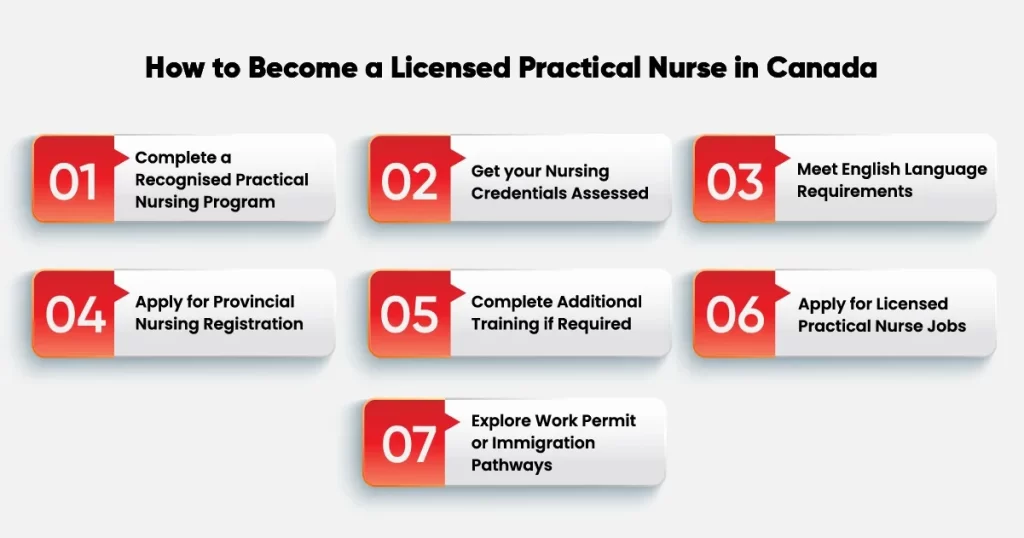
Here is the step-by-step process to work as a Licensed Practical Nurse in Canada. While details can vary by province, the overall pathway follows a similar structure nationwide.
Step 1: Complete a Recognised Practical Nursing Program
You must complete a recognised Practical Nursing diploma or certificate from an approved institution. In Canada, these programs include classroom-based learning along with mandatory clinical training.
For internationally educated nurses, your qualification must be assessed to determine whether it is comparable to Canadian practical nursing education standards.
Step 2: Undergo Credential Assessment (for International Applicants)
If you completed your nursing education outside Canada, a credential assessment is usually required. This process reviews your academic background, course content, and clinical training.
The assessment outcome helps determine whether you can proceed directly to licensing or if additional training or a bridging program is required.
Step 3: Apply for Provincial Nursing Registration
Licensed Practical Nurses must be registered with the provincial or territorial nursing regulatory body before they are allowed to practise.
The registration process may include document verification, competency assessment, and regulator approval. Without provincial registration, employment as an LPN is not permitted.
Step 4: Meet English Language Requirements
English language proficiency is required for safe nursing practice and regulatory approval. Applicants may need to submit results from recognised language tests such as IELTS or other approved exams.
Language score requirements vary by province and may differ for licensing and immigration purposes.
Step 5: Complete Any Additional Training or Supervised Practice (If Required)
Based on assessment results, some applicants may be asked to complete:
- Bridging or refresher programs
- Additional coursework
- Supervised clinical practice
These steps are typically required when there are gaps between previous education and Canadian standards.
Step 6: Apply for LPN Jobs
Once registered or eligible for registration, you can begin applying for LPN roles. Licensed Practical Nurses are commonly employed in:
Hospitals
- Long-term care facilities
- Rehabilitation centres
- Clinics and community healthcare settings
Employers usually review your registration status, clinical background, and availability to work within the province.
Step 7: Explore Immigration Pathways (If Applicable)
Healthcare jobs in Canada continue to offer strong opportunities for internationally trained Licensed Practical Nurses (LPNs), depending on provincial demand and individual profiles. Immigration eligibility is generally assessed based on education, language ability, work experience, and licensing status. Stronger alignment across these factors improves long-term employment and settlement prospect
Licensed Practical Nurse Jobs in Canada
Here are some of the Licensed Practical Nurse jobs in Canada:
- Staff Nurse
- Elderly Care Nurse
- Home Care Nurse
- Rehabilitation Nurse
- Paediatric Care Assistant
- Mental Health Support Nurse
- Clinic Nurse
- Palliative Care Nurse
- Long-Term Care Nurse
- Community Health Nurse Assistant
Some of these roles may be accessed through Jobs in Canada with Visa Sponsorship, depending on employer policies and provincial healthcare needs.
Best Provinces in Canada for Licensed Practical Nurse Jobs
The best provinces in Canada for Licensed Practical Nurse jobs include Ontario, British Columbia, Alberta, Nova Scotia, Saskatchewan, and Manitoba. This is mainly due to rising healthcare needs and staffing requirements.
Ontario – LPN roles are commonly available in hospitals, long-term care homes, rehabilitation centres, and home healthcare services
British Columbia – Demand is seen across elderly care, assisted living facilities, and community healthcare settings
Alberta – Employment opportunities exist in hospitals, rural healthcare centres, continuing care facilities, and emergency care units
Nova Scotia – LPN demand is growing in clinics, public healthcare services, and long-term care facilities
Saskatchewan – Opportunities are available in regional hospitals, nursing homes, and community healthcare centres
Manitoba – Steady demand exists in rehabilitation services, senior care facilities, and patient care settings
Licensed Practical Nurse Salary in Canada
The average salary of a Licensed Practical Nurse in Canada is around CAD 55,000 and CAD 75,000 a year. Your real income will vary depending on years of experience, province of work, type of healthcare facility you work at and your shift pattern including overtime.
Typically, Licensed Practical Nurse salaries in Canada increase over time. Salary growth is affected by experience level, other clinical skills, availability for overtime and the need for that role within the health system.
Average Licensed Practical Nurse Salary in Canada by Experience Level:
Here is the average Licensed Practical Nurse salary in Canada by experience level:
Entry-Level Licensed Practical Nurse Salary in Canada: CAD 50,000 to CAD 58,000 per year
Mid-Level Licensed Practical Nurse Salary in Canada: CAD 58,000 to CAD 68,000 per year
Experienced Licensed Practical Nurse Salary in Canada: CAD 70,000 to CAD 75,000 or higher per year
Licensed Practical Nurse vs Registered Nurse
Choosing between an LPN and RN career in Canada depends on your career goals, study duration, budget, and preferred job responsibilities.
Let’s see the difference between Licensed Practical Nurse and Registered Nurse in Canada in detail:
| Factors | Licensed Practical Nurse (LPN) | Registered Nurse (RN) |
|---|---|---|
| Education Requirement | Practical nursing diploma or equivalent nursing education | Bachelor of Science in Nursing (BSN/BScN) or equivalent nursing degree |
| Course Duration | Usually 2 years | Usually 4 years |
| Licensing Body | Provincial nursing regulatory body | Provincial nursing regulatory body |
| Job Responsibilities | Basic nursing care, patient support, monitoring, and medication administration within scope | Comprehensive patient assessments, care planning, complex interventions, and patient education |
| Work Settings | Clinics, nursing homes, hospitals, rehabilitation centres, long-term care | Hospitals, emergency care, specialized units, community health, acute care |
| Scope of Practice | More limited compared to RN | Broader and more independent |
Conclusion
Licensed Practical Nurses remain in steady demand across Canada due to ongoing healthcare staffing needs across provinces and care settings. Salary levels vary by province, experience, and employer, with continued opportunities through both public and private healthcare systems.
For official and up-to-date information on eligibility, work permits, and permanent residence pathways for nurses, refer to Immigration, Refugees and Citizenship Canada (IRCC).