



Australia has a labour gap, and a growing list of skilled workers ready to fill it. Bridging the two is the Australia Subclass 482 Visa, now officially the Skills in Demand (SID) Visa Australia’s main employer-sponsored work visa.
But it’s not the visa it was two years ago. Since the 2024 overhaul, the streams, occupation list, salary thresholds, and PR pathway have all changed and they keep shifting every July. If your information isn’t current, your application plan might not be either.
This guide covers exactly where things stand.
Table Of Content
1What is Subclass 482 Visa in Australia?2Australia Subclass 482 Visa Requirements3482 Visa Occupation List4How to Get a 482 Visa in Australia5Australia 482 Visa Processing Time6Age Limit for 482 Visa in Australia7New Rules for 482 Visa to Permanent Residency8Conclusion9Frequently Asked Questions
What is Subclass 482 Visa in Australia?
The Subclass 482 Visa, also known as the Skills in Demand (SID) Visa, is a temporary work visa that allows Australian employers to hire skilled overseas professionals when qualified local workers are unavailable to fill specific positions.
Designed to help businesses overcome workforce shortages, the Australia Subclass 482 Visa also gives eligible skilled workers the opportunity to build their careers, gain international work experience, and live in Australia. Depending on the applicant’s occupation and eligibility, this visa can also lead to Australian permanent residency (PR).
Key Features of the Australia Subclass 482 Visa
- Take up employment with a licensed sponsoring employer.
- Remain in Australia for as long as 4 years, depending on the visa stream you qualify under.
- Include immediate family members, such as a partner and dependent children, on your application.
- Move freely in and out of the country throughout your visa validity.
- Build hands-on experience in sectors facing skill shortages.
- Qualify for permanent residency through the Subclass 186 Temporary Residence Transition stream after 2 years with your sponsor.
- Apply based on your occupation’s listing under the applicable skilled occupation list.
Australia Subclass 482 Visa Requirements
To be eligible for the Australia Subclass 482 Visa (Skills in Demand Visa), you must meet several requirements set by the Australian Government. These requirements ensure that only qualified skilled workers fill genuine job vacancies that cannot be filled by local workers. Depending on your visa stream and occupation, additional eligibility criteria may also apply.
1. Employer Sponsorship Requirement
Since the Subclass 482 Visa is employer-sponsored, it cannot be applied for independently. A valid job offer must be held from an Australian employer that has been approved as a Standard Business Sponsor (SBS), or one that operates under an eligible Labour Agreement with the Australian Government.
The following must be met by the employer:
- Legal operation within Australia must be maintained.
- Approval to sponsor overseas skilled workers must be held.
- A genuine full-time position must be nominated for the applicant.
- Where required, it must be shown that no suitably qualified Australian worker could be found for the role.
If employer sponsorship is not secured, eligibility for the visa cannot be established.
2. Occupation Eligibility Requirement
The occupation nominated for the visa must fall within the appropriate Subclass 482 stream.
Depending on the occupation and salary level, one of the following must apply:
- Inclusion on the Core Skills Occupation List (CSOL).
- Eligibility criteria for the Specialist Skills Stream must be met.
- Coverage under an approved Labour Agreement.
The occupation stated in the employer’s nomination must be accurately matched to the applicant’s qualifications and work history.
3. Work Experience Requirement
At least one year of relevant full-time work experience (or an equivalent period of part-time or casual work) must be held in the nominated occupation or a closely related field.
The following should be reflected in this experience:
- Direct relevance to the nominated occupation must be shown.
- Practical skills required for the role must be demonstrated.
- The experience should generally have been gained within the last five years.
Supporting documents — such as employment reference letters, salary slips, tax records, or employment contracts — may be requested to verify this experience.
4. Skills and Qualifications Requirement
The qualifications, technical skills, licences, or professional registrations required to perform the nominated occupation in Australia must be held by the applicant.
Depending on the occupation, the following may be required:
- A university degree, diploma, or trade qualification.
- Professional registration or an occupational licence.
- A mandatory skills assessment, if applicable to the occupation or nationality.
Once this requirement is met, the knowledge and expertise needed to perform the nominated role to Australian standards is considered demonstrated.
5. English Language Proficiency
English language proficiency must be demonstrated by most applicants, unless an exemption is qualified for.
The following tests are accepted:
- IELTS
- PTE Academic
- TOEFL iBT
- Cambridge English
- Occupational English Test (OET)
The minimum score required depends on the test chosen, and valid results must be held at the time the visa application is submitted. Exemptions may be granted based on nationality or other eligibility factors.
6. Health Requirement
Australia’s health requirements must be met by all applicants.
The following may be required:
- A medical examination must be completed.
- Chest X-rays or additional tests may be required if requested.
- Australia’s public health standards must be satisfied.
If family members are included in the application, they may also need to complete health examinations.
7. Character Requirement
Australia’s character requirements must be satisfied before the visa can be granted.
This generally involves the following:
- Providing police clearance certificates from required countries.
- Declaring any criminal convictions or legal matters.
- Demonstrating good character throughout the assessment process.
If the character requirement is not met, the visa application may be refused.
8. Salary Requirement
A salary meeting the following conditions must be offered by the sponsoring employer:
- The applicable minimum skilled visa income threshold must be met or exceeded.
- Consistency with the Annual Market Salary Rate (AMSR) for the nominated occupation must be maintained.
- Comparability with the salary paid to Australian citizens or permanent residents performing equivalent work must be ensured.
This requirement is intended to ensure fair wages for overseas skilled workers and prevent underpayment.
9. Health Insurance Requirement
Unless eligibility for Medicare or coverage under a reciprocal healthcare agreement applies, adequate health insurance must be maintained throughout the stay in Australia.
The following should be covered by this insurance:
- Hospital treatment.
- Medical services.
- Emergency healthcare expenses.
Valid health insurance is considered an essential condition of the Subclass 482 Visa.
10. Visa Conditions Requirement
Although a pathway to permanent residency may be available for eligible applicants, all visa conditions must be followed throughout the stay in Australia.
This includes the following:
- Employment must be maintained in the nominated occupation.
- Work must only be carried out for the sponsoring employer, unless otherwise permitted.
- All Australian immigration laws and visa conditions must be followed.
If false information is provided, or visa conditions are breached, both the current visa and future Australian visa applications may be affected.
482 Visa Occupation List
The Australia Subclass 482 visa uses the Core Skills Occupation List (CSOL) for the Core Skills stream, while the Specialist Skills stream isn’t tied to a fixed list at all. The CSOL launched on 7 December 2024, replacing the older MLTSSL and STSOL lists, and contains around 456 Australia ANZSCO Code -coded occupations identified as in demand Jobs in Australia.
Here are some of the occupations included under the Australia Subclass 482 Visa occupation list, grouped across the major Core Skills Occupation List (CSOL) categories:
1. Healthcare & Medical
Registered Nurses, General Practitioners, Physiotherapists, Pharmacists, Medical Laboratory Scientists, Occupational Therapists, Midwives, and Aged Care Workers.
2. Information Technology
Software Engineers, Developer Programmers, ICT Business Analysts, Database Administrators, Systems Administrators, and ICT Security Specialists.
3. Engineering
Civil Engineers, Mechanical Engineers, Electrical Engineers, Mining Engineers, Chemical Engineers, and Structural Engineers.
4. Trades & Construction
Electricians, Plumbers, Carpenters, Welders, Diesel Motor Mechanics, Bricklayers, and Painting Trades Workers.
5. Education
Secondary School Teachers, Early Childhood Teachers, and Primary School Teachers.
6. Hospitality & Culinary
Chefs, Cooks, Pastry Cooks, and Bakers.
7. Business, Accounting & Other Professional Roles
Accountant (General), Taxation Accountant, Management Accountant, Marketing Specialist, and Public Relations Professional.
Also Included
Child Care Worker, Beauty Therapist, Retail Manager, and Tour Guide are among the newer additions to the list.
How to Get a 482 Visa in Australia
Getting a Subclass 482 visa in Australia involves three linked applications: sponsorship, nomination, and the visa itself usually driven by your employer with your input.
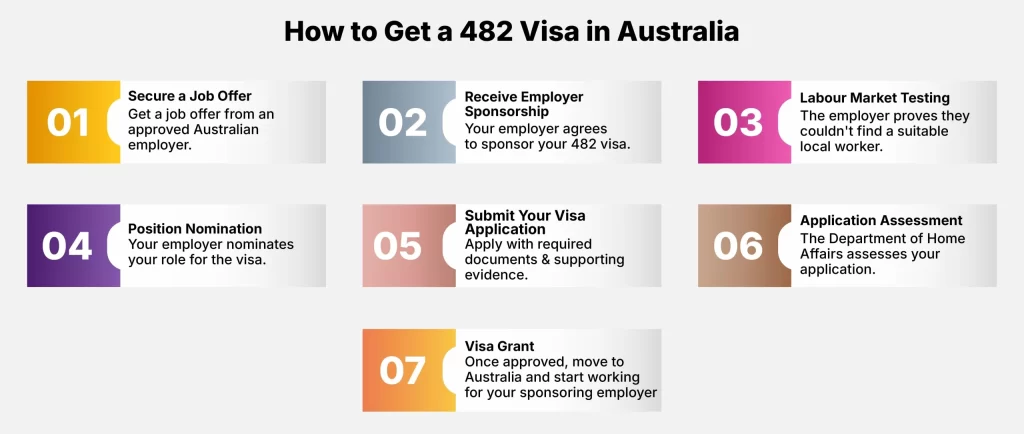
Here’s the simple step-by-step process to get a 482 Visa in Australia:
Step 1: Get a Genuine Job Offer
Find an Australian employer willing to sponsor you for a role that matches an eligible occupation under the Core Skills or Specialist Skills stream.
Step 2: Employer Becomes an Approved Sponsor
If the business is not already approved, it must apply to the Department of Home Affairs to become a Standard Business Sponsor (SBS). This typically takes 3 to 6 weeks for non-accredited sponsors and is faster for accredited sponsors.
Step 3: Labour Market Testing (Core Skills Stream)
Before nominating you, the employer must demonstrate that the role has been advertised on approved platforms for at least 4 weeks within the 4 months prior to lodging the nomination.
Step 4: Employer Lodges the Nomination
The employer nominates the position, confirming that the occupation is eligible, the salary meets required thresholds, and the role is genuine.
Step 5: You Lodge Your Visa Application
Once the nomination is approved, you submit your visa application with supporting documents such as your passport, English test results, health checks, and police certificates. These steps can sometimes be lodged simultaneously to save time.
Step 6: Department of Home Affairs Assesses Your Application
The Department checks that all eligibility requirements are met before making a decision.
Step 7: Visa Grant
If all legislative criteria are satisfied, your visa is granted and you can travel to Australia to begin work with your sponsor.
Australia 482 Visa Processing Time
The Australia Subclass 482 Visa processing time typically takes anywhere from a few weeks to around 10 months, depending on your visa stream and how complete your application is. The Specialist Skills stream is fastest, Core Skills (used by most applicants) takes the longest, and Labour Agreement falls in between.
The Department of Home Affairs publishes processing times as two benchmarks, the time within which 50% of applications are decided, and within which 90% are decided.
| Stage | 50% of applications | 90% of applications |
|---|---|---|
| Sponsorship (SBS) | 12 days | 67 days |
| Nomination | 17 days | 9 months |
| Visa – Specialist Skills | 10 days | 57 days |
| Visa – Core Skills | 83 days | 10 months |
| Visa – Labour Agreement | 5 months | 8 months |
Age Limit for 482 Visa in Australia
There is no age limit for the Skills in Demand (Subclass 482) visa itself, unlike several other Australian skilled migration visas such as the Subclass 189 and 190, which cap eligibility at 45 years, the 482 remains open to applicants of any age, provided they meet all other requirements. Unlike Subclass 189 and Subclass 190 visas, the Subclass 482 Visa isn’t points-tested, so you don’t need to use an Australia PR Points Calculator to qualify. However, if you’re considering a future transition to a points-tested skilled migration pathway, an Australia PR Points Calculator can help estimate your eligibility.
However, age becomes relevant if you’re planning to use the 482 as a stepping stone to permanent residency. To transition to PR via the Subclass 186 Temporary Residence Transition (TRT) stream, you generally must be under 45 years of age at the time of application, along with meeting the required work experience and English language criteria. So while you can hold a 482 visa well past 45, applicants hoping to eventually secure PR through this pathway should factor the 45-year cutoff into their planning.
New Rules for 482 Visa to Permanent Residency
Here are the new rules for Australia Subclass 482 Visa holders who want to apply for permanent residency:
Shorter Work Requirement for PR: The minimum employment period for the Subclass 186 Temporary Residence Transition (TRT) stream was reduced from 3 years to 2 years, making PR accessible significantly sooner for 482 holders.
Reduced Work Experience for the 482 Itself: Applicants previously needed at least 2 years of relevant work experience to qualify for employer sponsorship. Now, only 1 year of relevant experience gained within the past 5 years is required, a change that helps candidates get onto the pathway earlier.
Faster Route for Recent Graduates: International graduates on a Temporary Graduate Visa (Subclass 485) can now transition to employer sponsorship sooner because of the reduced experience threshold.
New Occupation List Structure: The Core Skills Occupation List (CSOL) replaced the old MLTSSL and STSOL, consolidating around 456 occupations that determine eligibility for both the 482 Core Skills stream and the 186 Direct Entry pathway.
Updated English Requirements: New English language rules apply to all SID applications lodged on or after 13 September 2025, with an expanded list of approved tests and a Single Skill Retake option.
Age Still Matters for PR: Applicants must generally be under 45 years of age to apply for the 186 TRT stream, and must meet a higher English requirement (IELTS 6.0 overall) compared to the 5.0 needed for the 482 itself.
Annual Salary Indexing: Salary thresholds for both the 482 and the PR pathway now index every July, so the income bar for eligibility shifts each year.
Employer Commitment Required: Your sponsoring employer must agree to nominate you for permanent residency, the 482 visa alone doesn’t guarantee this step happens automatically.
Conclusion
The Australia Subclass 482 Visa (Skills in Demand Visa) remains one of the most practical routes for skilled professionals to work in Australia and eventually settle there permanently. With reduced work experience requirements, a broader occupation list, and a faster 2-year pathway to PR through the Subclass 186, the visa has become considerably more accessible since the 2024 reforms. That said, salary thresholds, occupation eligibility, and English test requirements are updated regularly, so it’s important to confirm the latest details before you apply.
For the most accurate and up-to-date information, always refer to the official Department of Home Affairs Skills in Demand visa page.



Hi sir please i need a job 🙏🏻
Hi Prankrishna,
Thank you for your interest.
CanApprove can assist you. Please note that we are not a job consultancy, so we do not provide overseas job placements or recruitment services.
Our immigration experts can assess your profile and guide you on the most suitable work visa or employer-sponsored visa options based on your qualifications, work experience, and the country you wish to migrate to.
Please share your qualifications and experience, and we’ll assist you further. BOOK A FREE CONSULTATION NOW!
How do I know if my Work and Holiday (subclass 462) visa ballot have approved ?
Hi S Nafeesathul,
If you registered for the Australia Work and Holiday (subclass 462) ballot, you can check your registration status through ImmiAccount. Australia’s Department of Home Affairs says successful applicants will be notified if they are randomly selected