

If you are planning to move to Germany for work, study, vocational training, family reunification, or permanent settlement? Your German language certification can be an important part of your immigration journey.
However, there is no single German language certificate or language level that applies to every immigration pathway.
This guide explains the accepted German language exams, CEFR levels, immigration requirements, certificate validity, costs and the steps to obtain an official German language certificate in 2026.
Table Of Content
1What Is a German Language Certification for Immigration? 2Which German Language Certificate Is Valid in Germany? 3Who Needs a German Language Certification for Immigration? 4German Language Levels Explained (A1 to C2) 5Accepted German Language Certification Exams for Immigration 6Which German Language Certificate Is Best for Immigration? 7German Language Requirements for Different Immigration Pathways 8How to Get a German Language Certification 9How Much Does a German Language Certification Cost In India? 10Goethe-Institut German Exam Fees in India 11How Long Is a German Language Certificate Valid? 12Frequently Asked Questions
What Is a German Language Certification for Immigration?
A German language certification is an official document proving your German language proficiency at a specific level.
Unlike simply completing a German language course, a recognized language certificate demonstrates that you have passed a standardized German language assessment.
Most recognized German language exams are aligned with the Common European Framework of Reference for Languages (CEFR), which uses six levels:
- A1 – Beginner
- A2 – Elementary
- B1 – Intermediate
- B2 – Upper-intermediate
- C1 – Advanced
- C2 – Proficient
The certificate normally assesses important language skills such as:
- Reading
- Listening
- Writing
- Speaking
For example, the Goethe-Institut offers German examinations from A1 to C2 and describes its certificates as internationally recognized proof of German language knowledge for visa procedures, professional recognition and university admission.
Which German Language Certificate Is Valid in Germany?
If your visa requires proof of German language skills, make sure your certificate comes from a recognized examination provider.
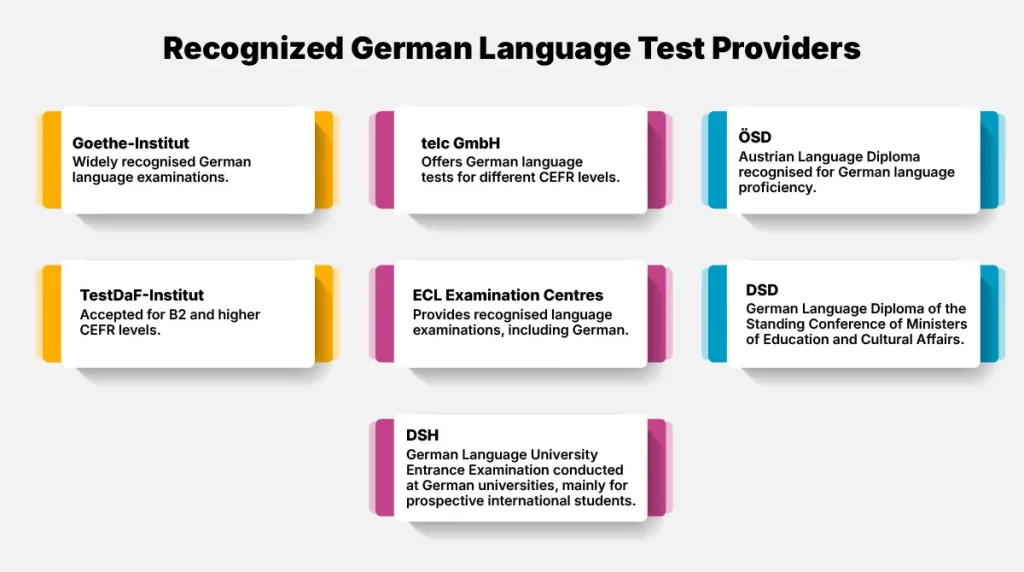
The Make it in Germany portal currently lists the following providers:
- Goethe-Institut e.V.
- telc GmbH
- Austrian Language Diploma (ÖSD)
- TestDaF-Institut e.V. – for B2 and higher CEFR levels
- ECL examination centres
- German Language Diploma of the Standing Conference of Ministers of Education and Cultural Affairs (DSD)
- DSH (German Language University Entrance Examination) at a German university, for prospective international students
This means that Goethe is not the only German language certificate accepted for German immigration.
However, the exact certificate and level you need can depend on your visa category and individual circumstances. Always verify the current requirement before booking your German language assessment.
Who Needs a German Language Certification for Immigration?
Not everyone who wants to move to Germany needs a German language certification. The language requirement depends on your visa category, immigration pathway, profession, study programme and individual circumstances.
Some German immigration routes have no legal German language requirement, while others require proof of a specific level, such as A1, A2, B1 or B2 under the Common European Framework of Reference for Languages (CEFR).
You may need language proof if you are applying for:
- Family reunification
- Vocational training
- A visa to seek vocational training
- Certain recognition or qualification routes
- The Opportunity Card through the points system
- Naturalisation
- Certain regulated professions
- University programmes taught in German
For some skilled-worker immigration routes, German language proof may not be a general visa requirement. However, German language skills can still be extremely valuable for employment and everyday life.
However, having no legal language requirement does not mean that German language skills are unnecessary. Learning German can improve your employment opportunities, workplace communication and everyday life in Germany.
German Language Levels Explained (A1 to C2)
Understanding CEFR levels is essential before choosing a German language exam.
A1 – Beginner
At A1, you can understand and use basic German expressions.
You can generally:
- Introduce yourself
- Give basic personal information
- Ask and answer simple questions
- Communicate in familiar everyday situations
A1 is commonly associated with basic language requirements, including certain family-reunification and Opportunity Card situations.
A2 – Elementary
At A2, you can communicate in simple, routine situations.
You can discuss familiar subjects such as:
- Family
- Shopping
- Work
- Housing
- Daily activities
A2 is relevant to certain qualification-recognition pathways. For example, applicants applying for a visa to have their foreign professional qualifications recognized generally need at least A2 German.
The same minimum level applies to the recognition partnership route.
B1 – Intermediate
B1 represents a more independent level of German language proficiency.
You can generally:
- Handle everyday conversations
- Explain experiences
- Describe plans
- Understand the main points of familiar topics
- Communicate while travelling or living in Germany
B1 is particularly important for vocational training. The official German government portal states that applicants for vocational training will normally need German at B1 when their language skills have not already been assessed by the training institution or covered through a preparatory course.
B2 – Upper-Intermediate
At B2, you can communicate with considerably more independence and handle complex conversations.
For a German student visa, B2 is generally the required level where German-language skills are required, although the exact requirement depends on the chosen study programme.
B2 can be particularly useful for:
- Skilled employment
- Professional communication
- Certain regulated professions
- University-related purposes
- Healthcare and professional fields
Students should therefore check the language requirement of their specific university and programme before choosing a German language exam.
TestDaF examinations are mapped to B2 and C1 levels and are primarily designed around the language requirements of university study in Germany.
C1 – Advanced
C1 demonstrates advanced German language skills.
You can understand complex texts, communicate fluently and use German effectively in academic and professional environments.
Certain German-taught university programmes and professional roles may require C1.
C2 – Proficient
C2 is the highest CEFR level.
It represents highly advanced German language proficiency and the ability to understand and communicate with a very high degree of fluency and precision.
Accepted German Language Certification Exams for Immigration
If you need to prove your German language proficiency for immigration, choosing the right examination is important. Germany recognizes specific standardized German language exams for visa purposes.
Goethe-Zertifikat
The Goethe-Institut offers standardized German language examinations from A1 to C2. The exams assess key language skills including reading, listening, writing and speaking.
Goethe certificates are widely recognized and can be used as proof of German language proficiency for various purposes, including visa procedures, professional recognition and university admission.
Best suited for:
General immigration, family reunification, professional recognition, employment and other German-language requirements.
telc German Language Exams
telc – The European Language Certificates offers German language examinations across different CEFR levels, from beginner to advanced proficiency.
This test provides general German examinations as well as examinations designed for specific purposes, including professional and healthcare-related language skills.
The appropriate telc examination depends on the level and purpose for which you need to demonstrate your German language qualification.
Best suited for:
Immigration, employment, vocational training, professional purposes and applicants who need German language proof for specific professional fields.
ÖSD German Language Exams
The Österreichisches Sprachdiplom Deutsch (ÖSD) is an internationally recognized examination system for German language proficiency.
ÖSD offers examinations covering A1 to C2, allowing candidates to obtain an official German language certificate based on their level of proficiency.
The examinations assess skills such as reading, listening, writing and speaking, depending on the specific exam.
Best suited for:
Immigration, general German language certification, professional purposes and applicants looking for an alternative recognized examination provider.
TestDaF
The TestDaF (Test Deutsch als Fremdsprache) is a German language examination primarily designed for people who need to demonstrate German proficiency for higher education in Germany.
TestDaF assesses German language skills at approximately B2 to C1 level under the CEFR. The examination tests reading, listening, writing and speaking.
The result is reported using TestDaF levels (TDN), with TDN 3, TDN 4 and TDN 5 corresponding to different levels of German proficiency.
Best suited for:
International students applying to German universities and applicants who need advanced German language proof for academic purposes.
ECL German Language Examination
The ECL (European Consortium for the Certificate of Attainment in Modern Languages) examination system provides standardized language assessments, including German.
ECL examinations assess practical language skills and can provide evidence of German language proficiency at the relevant CEFR level.
For German visa purposes, applicants should ensure that the specific ECL examination and level meet the requirements of their intended immigration pathway.
Best suited for:
Applicants who need recognized German language proof and whose specific visa or immigration pathway accepts the relevant ECL certificate.
German Language Diploma (DSD)
The Deutsches Sprachdiplom (DSD), or German Language Diploma of the Standing Conference of Ministers of Education and Cultural Affairs, is a German language qualification associated primarily with the school education system.
The DSD examination demonstrates German language proficiency at specified CEFR levels and can be particularly relevant for students who have followed a DSD programme.
Best suited for:
School students and applicants who have obtained their German language qualification through the DSD examination system.
DSH – German Language University Entrance Examination
The DSH (Deutsche Sprachprüfung für den Hochschulzugang) is a German language examination designed specifically for students seeking admission to a German university.
Unlike exams such as Goethe or telc, the DSH is conducted by German universities. It evaluates whether an international applicant has sufficient German language skills to study in a German-taught higher education programme.
The DSH is particularly relevant to applicants whose university or study programme requires this form of German language proof.
Best suited for:
International students applying to German-taught university programmes who need to demonstrate the required level of German for higher education.
Which German Language Certificate Is Best for Immigration?
There is no single “best” German language certificate for everyone.
The right choice depends on your:
- Immigration pathway
- Required CEFR level
- Intended profession
- University or employer requirements
- Location of the examination
- Exam availability
- Required visa documentation
Goethe vs telc vs ÖSD vs TestDaF
| Exam | Levels / Focus | Best For |
|---|---|---|
| Goethe | A1–C2 | General immigration and professional purposes |
| telc | A1–C2 | Immigration and professional language skills |
| ÖSD | A1–C2 | Immigration and general German proficiency |
| TestDaF | B2–C1 | University admission |
| ECL | Various levels | Certain recognized language requirements |
| DSD | School-based qualification | Students with DSD pathway |
If your goal is general immigration, Goethe, telc or ÖSD may be practical options depending on the exact requirement.
If your primary goal is studying at a German university, TestDaF may be more appropriate.
Always verify the current requirement before booking your examination.
German Language Requirements for Different Immigration Pathways
Your required German language qualification depends heavily on the immigration route.
The following table summarizes the German language requirements for major German visa and immigration pathways:
| Visa / Immigration Pathway | German Language Requirement |
|---|---|
| Work Visa for Qualified Professionals | No legal German language requirement |
| EU Blue Card | No legal German language requirement |
| Opportunity Card – Points System | At least A2 German or B2 English |
| Visa for Recognition of Foreign Qualifications | At least A2 German |
| Recognition Partnership Visa | At least A2 German |
| Work Visa for Professionally Experienced Workers | No legal German language requirement |
| Visa for Vocational Training (Ausbildung) | At least B1 German |
| Visa for Seeking a Vocational Training Place | At least B1 German |
| Self-Employment Visa | No legal German language requirement |
| Student Visa | Generally B2 German, depending on the study programme |
| Visa for Seeking a Place in Higher Education | Language requirement of the chosen study programme |
| Research Visa | No legal German language requirement |
| Visa for Language Acquisition | No legal German language requirement |
| Study-Related Internship EU | No legal German language requirement |
These requirements are based on the legal requirements under Germany’s Residence Act. However, additional language requirements may apply during professional qualification recognition, university admission or the visa application process at a German mission abroad.
How to Get a German Language Certification
Getting an official German language certificate usually involves five steps.
Step 1: Identify your immigration pathway
First determine whether you are applying for:
- Work
- Germany Opportunity Card
- Ausbildung
- Family reunification
- University
- Recognition of qualifications
- Permanent residence or citizenship
This tells you what level of German you may need.
Step 2: Determine your target CEFR level
Find out whether you need:
A1, A2, B1, B2, C1 or C2.
Do not automatically choose B2 or C1 simply because it is a higher level.
The correct level is the one required for your immigration or study purpose.
Step 3: Choose a recognized examination
Choose an appropriate provider such as:
- Goethe-Institut
- telc
- ÖSD
- TestDaF
- ECL
- DSD
Check that the specific exam is accepted for your intended purpose.
Step 4: Prepare for the German language assessment
You can prepare through:
- German language classes
- Online courses
- Self-study
- Practice tests
- Speaking practice
- German books and podcasts
- Mock examinations
Focus on all four skills:
- Lesen – Reading
- Hören – Listening
- Schreiben – Writing
- Sprechen – Speaking
Step 5: Take the examination
Register with an authorized examination centre.
After successfully completing the exam, you receive your official German language certificate.
Keep both the original certificate and digital copies safely because you may need them during the visa or residence process.
How Much Does a German Language Certification Cost In India?
In India, a German language certification exam generally costs around ₹10,000–₹25,000, depending on the examination provider and CEFR level. For example, current Goethe-Institut India fees for external candidates range from ₹9,400 for A1 to ₹26,000 for C2. Higher-level exams generally cost more than A1 and A2 exams, while fees for providers such as telc, ÖSD, TestDaF and DSH vary by examination centre and exam type.
Goethe-Institut German Exam Fees in India
| German Level | External Candidate | Internal Candidate* |
|---|---|---|
| A1 | ₹9,400 | ₹7,000 |
| A2 | ₹10,600 | ₹8,000 |
| B1 | ₹18,800 | ₹14,000 |
| B2 | ₹21,200 | ₹16,000 |
| C1 | ₹24,000 | ₹18,000 |
| C2 | ₹26,000 | ₹19,600 |
B1, B2, C1 and C2 may also be available as individual modules. The exact fee and availability should be confirmed with the examination centre before registration.
*Internal candidates may qualify for reduced fees under the Goethe-Institut’s applicable conditions.
Additional Costs to Consider
The examination fee is only part of the total cost of obtaining a German language qualification. You may also need to budget for:
- German language classes
- Study materials and books
- Mock tests and exam preparation
- Travel to the examination centre
- Retake fees, if required
Important: German language examination fees can change and may differ between centres. Always check the latest fee with the official examination provider before booking your exam.
How Long Is a German Language Certificate Valid?
A German language certificate generally does not have a fixed expiry date. However, this does not necessarily mean that an immigration authority, university or employer will accept a certificate regardless of how old it is.
For example, Goethe-Institut certificates from A1 to C2 are generally valid indefinitely. However, German authorities may require a certificate that was issued within a specific period for a visa application. The German Federal Foreign Office states that, as a general rule, the examination date should not be more than one year old for visa procedures, although the exact requirement can depend on the individual case.
ÖSD certificates are also generally valid indefinitely, but authorities may sometimes request more recent proof of language proficiency.