



Mechanical Engineers in Canada continue to find steady opportunities across manufacturing, energy, construction, transportation, automotive, and advanced technology sectors. With demand supported by ongoing infrastructure projects, industrial growth, and the need for skilled technical professionals, the field offers strong scope for qualified engineers. This blog explains the demand, requirements, job roles, visa sponsorship options, salaries, and steps to work as a mechanical engineer in Canada.
Table Of Content
1Are Mechanical Engineers in demand in Canada?2Requirements to Become a Mechanical Engineer in Canada3How to Become a Mechanical Engineer in Canada?4Mechanical Engineers Jobs in Canada5Mechanical Engineering Jobs in Canada with Visa Sponsorship6Mechanical Engineer Salary in Canada7Conclusion8Frequently Asked Questions
Are Mechanical Engineers in demand in Canada?
The demand for Mechanical Engineers in Canada remains steady, supported by the country’s need for skilled professionals across manufacturing, infrastructure, energy, transportation, and advanced technology sectors.
The demand for mechanical engineers in Canada is driven by:
- Ongoing infrastructure development and industrial projects across major provinces.
- Growth in manufacturing, automation, clean technology, and energy sectors.
- Demand for engineers in equipment design, production, maintenance, and project management.
- Replacement demand created by retirements and workforce movement.
- Consistent job opportunities in provinces such as Ontario, British Columbia, and Alberta.
- Employer demand for qualified engineers with strong technical, design, and problem-solving skills.
Requirements to Become a Mechanical Engineer in Canada
Becoming a mechanical engineer in Canada requires a recognised engineering qualification, relevant work experience, English language proficiency, professional licensing where required, and valid work rights or an eligible immigration pathway. For Mechanical Engineers in Canada, meeting these requirements is important for both employment and long-term career growth.
Mechanical engineers must also meet provincial engineering standards, as engineering is a regulated profession in Canada. Licensing is managed by provincial and territorial engineering regulatory bodies.
Educational Qualifications
A Bachelor’s degree or higher in mechanical engineering is usually the minimum requirement. Degrees in mechatronics, manufacturing, automotive, aerospace, or closely related engineering fields may also be considered if they include sufficient mechanical engineering content.
Key points include:
- Programs are typically 4 years full-time.
- Qualifications must be obtained from a recognised institution.
- Postgraduate qualifications can improve eligibility for senior, specialist, or research-based roles.
- Entry into these programs usually requires strong background knowledge in mathematics, physics, and sometimes chemistry.
Educational Credential Assessment
International applicants may need an Educational Credential Assessment for Canada Immigration to confirm whether their foreign qualification is equivalent to a Canadian credential. This is commonly required for immigration pathways and may also help employers understand the value of overseas education.
Practical Experience
While entry-level mechanical engineering roles may be available for fresh graduates, relevant work experience is strongly preferred by Canadian employers.
Relevant experience may include:
- Graduate mechanical engineer roles
- Internships or industrial training
- Manufacturing, energy, automotive, or building services experience
- Site-based roles involving mechanical systems, equipment, or maintenance
Experience typically covers:
- Mechanical design and CAD modelling
- Equipment selection, installation, and troubleshooting
- Plant operation, maintenance, and commissioning
- Quality control and safety compliance
- Project coordination and technical reporting
English Language Proficiency
Mechanical engineers must demonstrate strong English language ability for employment and immigration purposes.
Accepted tests may include:
- IELTS
- PTE Core
- CELPIP
- TOEFL
Higher language scores can improve immigration competitiveness under certain pathways and may also support better communication in professional engineering roles.
Professional Registration and Licensing
Mechanical engineering is regulated in Canada. To use the title “Professional Engineer” or “P.Eng.”, candidates must be licensed by the engineering regulator in the province or territory where they plan to work.
Mechanical engineers may need:
- Registration with a provincial or territorial engineering body
- Academic assessment
- Relevant engineering work experience
- Professional practice or ethics examination
- References or proof of supervised engineering experience
Some roles may allow candidates to work under supervision before full licensing, especially at the entry or junior level.
Certifications and Technical Skills
Certifications for mechanical engineers in Canada can improve employability, especially for specialised or senior roles.
Useful skills and certifications may include:
- AutoCAD, SolidWorks, CATIA, or similar design software
- ANSYS or other simulation tools
- Project management certifications
- HVAC or building systems knowledge
- Quality, safety, or maintenance-related certifications
- Knowledge of Canadian workplace safety and engineering standards
Work Rights and Immigration
To work as a mechanical engineer in Canada, applicants must have valid work rights through citizenship, permanent residency, a work permit, or another eligible immigration pathway. Some candidates may explore Canada PR Requirements through Express Entry, Provincial Nominee Programs, or employer-supported routes.
International applicants may also need to meet standard immigration steps such as a Canada Immigration Medical Exam, Canada Biometric Requirements, police clearance, and proof of funds, depending on the pathway.
Additional Requirements
Applicants must also remain competitive in the Canadian job market by:
Key considerations include:
- Keeping technical and software skills updated
- Understanding Canadian engineering codes, safety rules, and workplace standards
- Building industry networks and professional connections
- Gaining local experience where possible
- Following licensing requirements in the province where they plan to work
- Regularly exploring opportunities through Job Bank Canada, the Government of Canada’s official job portal, to stay informed about current openings, employer requirements, and labour market trends for mechanical engineers
Meeting these requirements can help mechanical engineers improve their chances of employment, licensing, and long-term career development in Canada.
How to Become a Mechanical Engineer in Canada?
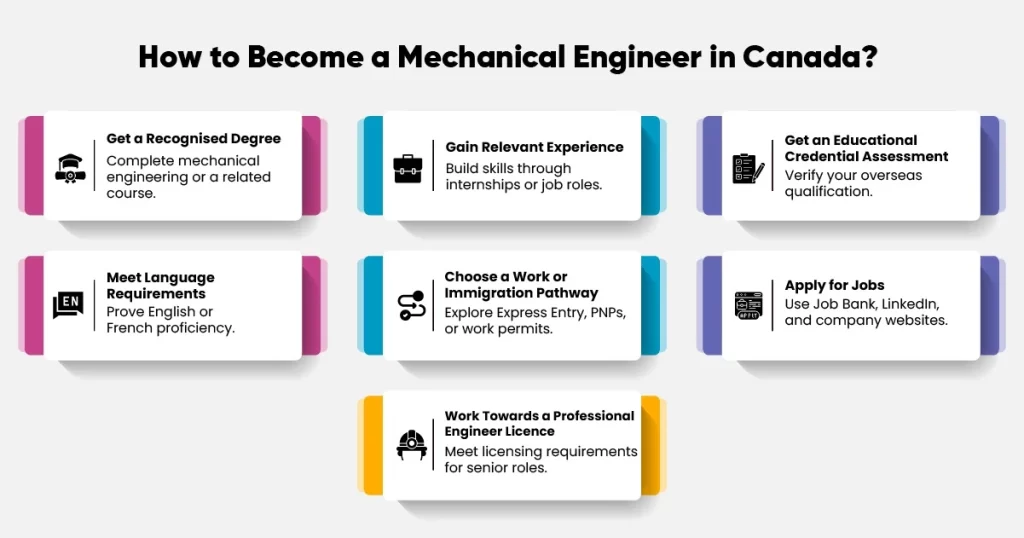
Here is the Step-by-Step Process to Work as a Mechanical Engineer in Canada
Step 1: Complete a Recognised Engineering Degree
You must complete a Bachelor’s degree in Mechanical Engineering or a closely related field. The qualification should be recognised and comparable to Canadian engineering standards for employment, licensing, and immigration purposes.
Step 2: Gain Relevant Work Experience
Practical experience is strongly preferred by employers and improves job prospects.
This can include:
- Graduate engineer roles
- Internships or industrial training
- Design, manufacturing, HVAC, energy, or maintenance roles
Step 3: Get an Educational Credential Assessment
International graduates may need an Educational Credential Assessment for Canada Immigration to confirm that their qualification is equivalent to a Canadian credential. Mechanical engineers are classified under NOC 21301.
Step 4: Meet Language Requirements
You must demonstrate English or French proficiency through an approved test. Higher language scores can improve your immigration profile and job prospects.
Step 5: Apply for a Suitable Immigration or Work Pathway
Choose a pathway based on your profile and job options.
Common routes include:
- Express Entry
- Provincial Nominee Programs
- Employer-supported work permits
Step 6: Search and Apply for Mechanical Engineer Jobs
Mechanical engineering roles are listed on Job Bank Canada, LinkedIn, Indeed, and company websites. Employers usually consider qualifications, experience, technical skills, and work permit status.
Step 7: Work Toward a Professional Engineer Licence
To build a long-term career, mechanical engineers should work toward P.Eng. licensing through the relevant provincial engineering regulator. Keep technical skills updated, follow Canadian safety standards, and continue professional development.
Mechanical Engineers Jobs in Canada
The job market for mechanical engineers in Canada continues to offer opportunities across industries such as manufacturing, energy, construction, automotive, aerospace, building services, and industrial operations. Roles range from entry-level graduate positions to senior technical, project-based, and leadership roles, making Canada an attractive destination for qualified mechanical engineering professionals.
Here’s a list of common active job post names:
- Graduate Mechanical Engineer
- Mechanical Engineer
- Mechanical Engineer (Entry Level)
- Junior Mechanical Engineer
- Senior Mechanical Engineer
- Mechanical Design Engineer
- Mechanical Project Engineer
- HVAC Mechanical Engineer
- Manufacturing Mechanical Engineer
- Maintenance Mechanical Engineer
Mechanical Engineering Jobs in Canada with Visa Sponsorship
Mechanical engineering jobs in Canada with visa sponsorship may be offered when employers face labour shortages or need specialised engineering expertise. Sponsorship is usually employer-led and depends on job requirements, experience level, employer eligibility, and current Canadian immigration rules.
Common Sponsored Roles
Visa sponsorship is more common for experienced mechanical engineers whose skills match manufacturing, energy, infrastructure, construction, transportation, or industrial projects. These roles usually require a recognised engineering qualification, relevant experience, and eligibility for an LMIA-supported work permit or another suitable work permit option.
Mechanical Design Engineer: Designs mechanical components, systems, and assemblies using CAD software.
Maintenance Engineer: Supports equipment maintenance, reliability, and plant operations.
HVAC Engineer: Designs heating, ventilation, air conditioning, and refrigeration systems.
Manufacturing Engineer: Improves production processes, automation, and factory efficiency.
Mechanical Project Engineer: Oversees mechanical work from design through installation and commissioning.
Piping Engineer: Designs piping systems, pressure vessels, and fluid-handling infrastructure.
Automotive Engineer: Works on vehicle components, thermal systems, and EV-related technologies.
Reliability Engineer: Focuses on equipment performance, failure analysis, and asset integrity.
Building Systems Engineer: Supports building automation, controls, and energy-management systems.
R&D Mechanical Engineer: Works on product development, testing, and prototype validation.
Sponsoring Companies
Canadian employers may sponsor international mechanical engineers when they cannot fill specialised roles locally. Availability can change based on province, project activity, and labour market conditions.
Suncor, Cenovus, and TC Energy: May recruit engineers for energy, maintenance, and project roles.
Magna International and Linamar: May hire design and manufacturing engineers for automotive roles.
AtkinsRéalis, Worley, and Stantec: May recruit engineers for infrastructure, industrial, and project roles.
BC Hydro, Hydro-Québec, and Ontario Power Generation: May offer mechanical engineering roles in utilities and power projects.
Disclaimer: Visa sponsorship is subject to employer approval and current Canadian immigration regulations. Eligibility depends on qualifications, experience, licensing requirements, and work permit criteria at the time of application.
Mechanical Engineer Salary in Canada
Mechanical engineers in Canada typically earn around CAD$70,000–CAD$95,000 per year. Salaries vary based on experience, province, industry, and professional licensing. It is one of the highest paying jobs in canada.
Below is a simple salary overview based on experience:
- Entry-Level / Graduate Mechanical Engineer: CAD$55,000–CAD$75,000 per year.
- Mid-Career Mechanical Engineer: CAD$70,000–CAD$95,000 per year.
- Senior Mechanical Engineer: CAD$95,000–CAD$140,000 per year.
- Lead / Principal Mechanical Engineer: CAD$140,000–CAD$170,000 per year.
- Engineering Manager: CAD$150,000–CAD$220,000+ per year.
Pay can be higher in sectors such as oil and gas, power generation, manufacturing, mining support, and major infrastructure projects. P.Eng. licensing, specialised skills, and remote-site allowances can also increase total earnings.
Conclusion
Mechanical Engineers in Canada continue to have steady career opportunities across manufacturing, energy, construction, transportation, automotive, and infrastructure sectors. Skilled professionals with recognised qualifications, relevant experience, and professional licensing can explore job opportunities, employer-supported work permits, and long-term immigration options.
International applicants should meet key requirements such as educational credential assessment, English language proficiency, work experience, and provincial licensing requirements where applicable. For the latest information on work permits, Canada PR requirements, and application procedures, refer to the official website of Immigration, Refugees and Citizenship Canada.