



Germany is a premier destination for higher education, especially in the healthcare sector. The healthcare courses offered in Germany provide international students with an exceptional academic and professional foundation. The country is renowned for its world-class universities, state-of-the-art research facilities, and a significant demand for healthcare professionals. Whether you aim to be a biomedical researcher, public health specialist, nurse, or doctor, Germany presents a clear and cost-effective pathway to achieving your goals.
This guide includes all the vital information you need, such as tuition fees, top healthcare courses in Germany, answers to frequently asked questions from international students, and a brief overview of medical courses.
Table Of Content
1Benefits of Studying Healthcare in German2Best Healthcare Courses in Germany3Healthcare Courses in Germany Fees4Short Medical Courses in Germany for International Students5Conclusion6Frequently Asked Questions
Benefits of Studying Healthcare in Germany
1. Tuition-Free or Low-Cost Education
Germany is one of the most affordable destinations for quality education, as the majority of public universities do not charge tuition fees for undergraduate programs. Students are required to pay a nominal semester contribution fee.
2. World-Class Research and Clinical Exposure
Germany is home to leading research institutions and hospitals, making it a hub for medical research. Students gain access to internationally recognized clinical environments, state-of-the-art laboratories, and pioneering research opportunities.
3. High Demand for Healthcare Professionals
Germany is experiencing a substantial shortage of healthcare professionals, particularly nurses, doctors, and paramedical staff. International graduates who possess the appropriate qualifications have exceptional employment prospects.
4. Ausbildung (Vocational Training) Opportunities
Germany’s dual education system (Ausbildung) enables students to integrate classroom learning with paid on-the-job training in healthcare fields, including nursing, physiotherapy, and medical technology.
5. Pathway to Permanent Residency
Germany actively promotes the retention and employment of skilled healthcare graduates as a means of achieving permanent residency. Completing your studies or Ausbildung in Germany significantly enhances your application for a work visa and eventual permanent residency.
6. Multicultural Environment
Germany’s universities are characterized by a welcoming environment that is highly international, with a significant and active Indian student community. Students from all over the world are welcome to attend.
7. Part-Time Employment Opportunities
International students are permitted to work for a maximum of 20 hours per week during the semester, which assists them in managing their expenses and acquiring work experience in Germany.
8. Scholarships Available
International students in Germany have access to various scholarships, such as those provided by DAAD, Erasmus+, and individual universities, which further enhances the financial accessibility of the program.
Best Healthcare Courses in Germany
Germany offers a broad spectrum of healthcare courses, from undergraduate medicine to specialized postgraduate programs.
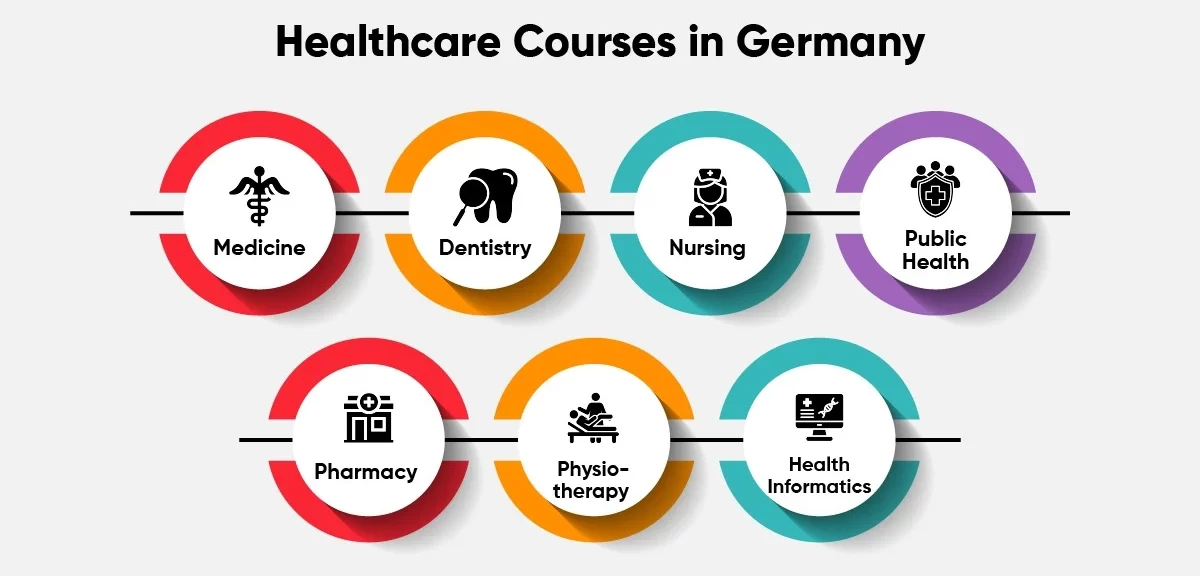
Below are the best healthcare courses in Germany for international students:
1. Medicine
2. Dentistry
3. Nursing
4. Public Health
5. Pharmacy
6. Physiotherapy
7. Health Informatics
1. Medicine
Germany’s most popular healthcare course is medicine. Students prepare for various medical careers in this state-regulated program that combines rigorous theoretical study with extensive clinical training.
| Factors | Details |
|---|---|
| Course Duration | 6 years (including a practical year) |
| Average Tuition Fees | Public Universities: €0–€1,500 per year; Private Universities: €5,000–€20,000+ per year |
| Popular Courses | General Medicine, Surgery, Internal Medicine, Pediatrics, Neurology |
| Some of the Top Universities | Heidelberg University, Charité – Universitätsmedizin Berlin, LMU Munich |
| Job Opportunities | General Practitioner, Surgeon, Specialist Physician, Hospital Consultant |
Requirements to Study Medicine in Germany for International students
- Successful completion of the 12th grade or an equivalent qualification from a recognized institution.
- A strong academic foundation in chemistry and biology.
- Proof of German language proficiency (B2/C1 level) or IELTS/TOEFL for English-medium programs.
- A student visa and a valid passport.
- Health insurance coverage.
- APS certificate (applicable to students from specific countries).
- Entrance examinations or interviews may be mandatory at certain universities.
Medicine Course Fees in Germany
The average tuition fee for medicine courses in Germany ranges from €0 to €20,000+ per year; it varies depending on the type of institution.
| Type of Institution | Annual Fees on an Average |
|---|---|
| Public Universities | €0–€1,500 |
| Private Universities | €5,000–€20,000+ |
| Semester Contribution Fee | €150–€350 per semester |
2. Dentistry
Dentistry is a rigorous, practically intensive healthcare course in Germany that prepares students for comprehensive oral healthcare. German dental degrees are recognized across the European Union and beyond. This course is available in the best Public Universities in Germany.
| Factors | Details |
|---|---|
| Course Duration | 5 years |
| Average Tuition Fees | Public Universities: €0–€1,500 per year; Private Universities: €5,000–€20,000+ per year |
| Popular Courses | General Dentistry, Orthodontics, Oral Surgery, Dental Research |
| Some of the Top Universities | Free University of Berlin, University of Freiburg, University of Münster |
| Job Opportunities | General Dentist, Orthodontist, Oral Surgeon, Dental Researcher |
Requirements to Study Dentistry in Germany for International Students
- Completion of 12th grade or equivalent qualification from a recognized institution.
- Strong academic background in biology and chemistry.
- Proof of German language proficiency (B2/C1 level).
- Valid passport and student visa.
- Health insurance coverage.
- APS certificate (for students from certain countries where applicable).
Dentistry Course Fees in Germany
The average tuition fee for dentistry in Germany ranges from €0 to €25,000+ per year, depending on the type of institution.
| Institution Type | Average Annual Fees |
|---|---|
| Public Universities | €0–€1,500 |
| Private Universities | €5,000–€20,000+ |
| Semester Contribution Fee | €150–€350 per semester |
3. Nursing – Ausbildung & Degree
In Germany, nursing is one of the most sought-after healthcare courses. The curriculum emphasizes clinical practice, healthcare ethics, medical procedures, and patient care. Practical training in hospitals, clinics, and healthcare facilities provides students with practical experience. So, without a doubt it is one of the best Courses in Germany.
| Factors | Details |
|---|---|
| Course Duration | 3 years (Ausbildung) or 3–4 years (Bachelor’s degree) |
| Average Tuition Fees | Public Universities: €0–€1,500 per year; Private Universities: €5,000–€20,000+ per year |
| Popular Courses | Nursing Science, General Nursing, Advanced Nursing Practice, Pediatric Nursing, Geriatric Nursing |
| Some of the Top Universities | Charité – Universitätsmedizin Berlin, University of Witten/Herdecke, Hochschule Bremen, Frankfurt University of Applied Sciences, Alice Salomon University of Applied Sciences Berlin |
| Job Opportunities | Registered Nurse, Clinical Nurse, Elderly Care Nurse, Intensive Care Nurse, and Pediatric Nurse |
Requirements to Study Nursing in Germany for International Students
- Successful completion of the 12th grade or an equivalent qualification from a recognized institution.
- A strong academic foundation in biology and related sciences.
- Proof of German language proficiency (typically at the B1–B2 level or higher) is required, as the majority of nursing programs are conducted in German.
- A student visa and a valid passport.
- Health insurance coverage.
- APS certificate (applicable to students from specific countries).
- Interviews, entrance assessments, or prior healthcare-related experience may be necessary for admission to certain universities.
Nursing Course Fees in Germany
The average tuition fee for nursing courses in Germany ranges from €0 to €20,000+ per year, depending on whether you study at a public or private university.
| Institution Type | Average Annual Fees |
|---|---|
| Public Universities | €0–€1,500 |
| Private Universities | €5,000–€20,000+ |
| Semester Contribution Fee | €150–€350 per semester |
4. Public Health
Students who are interested in global health systems, epidemiology, health policy, and population-level health are drawn to public health courses in Germany. This is one of the most accessible and best healthcare courses in Germany for international students, as the majority of master’s programs are offered in English.
| Factors | Details |
|---|---|
| Course Duration | 1.5 to 2 years (Master’s) |
| Average Tuition Fees | Public Universities: €0–€1,500 per year; Private Universities: €5,000–€15,000+ per year |
| Popular Courses | Epidemiology, Global Health, Health Policy, Health Promotion, Environmental Health |
| Some of the Top Universities | Bielefeld University, University of Bremen, Heidelberg University |
| Job Opportunities | Public Health Officer, Epidemiologist, Health Policy Analyst, WHO/NGO Roles |
Requirements to Study Public Health in Germany for International Students
- Bachelor’s degree in a health-related field from a recognized institution.
- Proof of English proficiency (IELTS 6.5+ or equivalent) for English-medium programs, or German proficiency for German-taught programs.
- Valid passport and student visa.
- Health insurance coverage.
- APS certificate (for students from certain countries where applicable).
- Some programs may require relevant work or research experience.
Public Health Course Fees in Germany
The average tuition fee for public health courses in Germany ranges from €0 to €15,000+ per year, depending on the type of institution.
| Institution Type | Average Annual Fees |
|---|---|
| Public Universities | €0–€1,500 |
| Private Universities | €5,000–€15,000+ |
| Semester Contribution Fee | €150–€350 per semester |
5. Pharmacy
Pharmacy is one of the most professionally rewarding healthcare courses in the country, as Germany is a global leader in pharmaceutical research and development. The program is practically oriented and state-regulated.
| Factors | Details |
|---|---|
| Course Duration | 4 years + 6-month internship |
| Average Tuition Fees | Public Universities: €0–€1,500 per year; Private Universities: €5,000–€20,000+ per year |
| Popular Courses | Clinical Pharmacy, Pharmaceutical Chemistry, Drug Regulatory Affairs, Pharmacology |
| Some of the Top Universities | University of Bonn, LMU Munich, Freie Universität Berlin |
| Job Opportunities | Clinical Pharmacist, Pharmaceutical Researcher, Drug Regulatory Affairs Specialist |
Requirements to Study Pharmacy in Germany for International Students
- Successful completion of the 12th grade or an equivalent qualification with exceptional results in biology and chemistry.
- Proof of German language proficiency (C1 level) is required, as the program is conducted in German.
- A student visa and a valid passport.
- Health insurance coverage.
- APS certificate (applicable to students from specific countries).
- Admission necessitates an Abitur or an equivalent qualification.
Pharmacy Course Fees in Germany
The average tuition fee for pharmacy courses in Germany ranges from €0 to €20,000+ per year, depending on the type of institution.
| Institution Type | Average Annual Fees |
|---|---|
| Public Universities | €0–€1,500 |
| Private Universities | €5,000–€20,000+ |
| Semester Contribution Fee | €150–€350 per semester |
6. Physiotherapy
Physiotherapy is one of the most sought-after paramedical courses in Germany. There are both vocational (Ausbildung) and degree pathways that offer exceptional employment opportunities in sports facilities, hospitals, and clinics.
| Factors | Details |
|---|---|
| Course Duration | 3 years (Ausbildung) or 3–4 years (Bachelor’s) |
| Average Tuition Fees | Public Universities: €0–€1,500 per year; Private Universities: €5,000–€20,000+ per year |
| Popular Courses | Sports Physiotherapy, Neurological Rehabilitation, Pediatric Physiotherapy, Manual Therapy |
| Some of the Top Universities | SRH University Heidelberg, HAWK University, various Fachschulen |
| Job Opportunities | Physiotherapist, Rehabilitation Specialist, Sports Physiotherapist, Clinical Trainer |
Requirements to Study Physiotherapy in Germany for International Students
- Completion of 12th grade or equivalent qualification from a recognized institution.
- Proof of German language proficiency (B2 level minimum).
- Valid passport and student visa.
- Health insurance coverage.
- Physical fitness certificate in some cases.
- APS certificate (for students from certain countries where applicable).
Physiotherapy Course Fees in Germany
The average tuition fee for physiotherapy courses in Germany ranges from €0 to €20,000+ per year, depending on the type of institution.
| Institution Type | Average Annual Fees |
|---|---|
| Public Universities | €0–€1,500 |
| Private Universities | €5,000–€20,000+ |
| Semester Contribution Fee | €150–€350 per semester |
7. Health Informatics
Health informatics is a rapidly growing field combining medicine, technology, and data science. Germany is investing heavily in digital health infrastructure, making this one of the most future-proof healthcare courses in the country. This is among the best healthcare Courses in Germany
| Factors | Details |
|---|---|
| Course Duration | 3–4 years (Bachelor’s), 1.5–2 years (Master’s) |
| Average Tuition Fees | Public Universities: €0–€1,500 per year; Private Universities: €5,000–€15,000+ per year |
| Popular Courses | Digital Health, Clinical Data Management, E-Health Systems, Healthcare IT |
| Some of the Top Universities | University of Heidelberg, Osnabrück University of Applied Sciences, TU Berlin |
| Job Opportunities | Health Data Analyst, Digital Health Consultant, Clinical Systems Manager, E-health Developer |
Requirements to Study Health Informatics in Germany for International Students
- Completion of 12th grade or an equivalent qualification with a background in IT or health sciences.
- Proof of German or English language proficiency depending on the program.
- Valid passport and student visa.
- Health insurance coverage.
- APS certificate (for students from certain countries where applicable).
Health Informatics Course Fees in Germany
The average tuition fee for Health Informatics courses in Germany ranges from €0 to €15,000+ per year, depending on the type of institution.
| Institution Type | Average Annual Fees |
|---|---|
| Public Universities | €0–€1,500 |
| Private Universities | €5,000–€15,000+ |
| Semester Contribution Fee | €150–€350 per semester |
Healthcare Courses in Germany Fees
Healthcare courses in Germany typically cost between €0 and €1,500 per year at public universities, while private universities may charge between €5,000 and €20,000+ per year.
International students should include living expenses, health insurance, accommodation, and study materials in their budget, in addition to tuition fees.
Cost of Living for International Students
The average cost of living in Germany for international students ranges from €800 to €1,200 per month, covering accommodation, food, transportation, and health insurance.
Short Medical Courses in Germany for International Students
Germany offers a range of short medical courses and certificate programs for international students and healthcare professionals. These courses are ideal for upskilling, professional development, and gaining specialized knowledge without committing to a full degree program.
Short Medical Courses in Germany for International Students include:
- First Aid and Emergency Medicine Training (Erste Hilfe)
- Certificate Programme in Geriatric Care (Altenpflege Basics)
- Digital Health and Telemedicine Short Courses (offered by Coursera, edX, and German universities)
- Clinical Research and Good Clinical Practice (GCP) Certificate Courses.
- Introduction to Public Health and Epidemiology (Short online courses offered by Heidelberg and TU Munich)
- Medical Coding and Billing Certificate (ICD-10 and DRG Coding)
- Short Courses in Nutrition and Dietetics
Conclusion
Germany’s top-tier healthcare education offers international students unmatched academic rigor, practical training, financial accessibility, and career prospects. Healthcare courses in Germany can transform your future, whether you choose a medical degree, nursing Ausbildung, Master’s in Public Health, or specialized program in health informatics or medical technology.
As an international student, especially from India, studying healthcare in Germany requires careful planning, including learning German, meeting entry requirements, getting a student visa, and finding the right scholarship. The compensation, a globally recognized qualification, high earning potential, and a path to life and work in Europe justify the decision.
Visit the official DAAD (German Academic Exchange Service) portal at www.daad.de for comprehensive information on universities, application deadlines, and scholarship opportunities.