




Canada’s healthcare system is stretched thin, and Nurse Practitioners are increasingly the ones stepping in to fill the gap. With family doctor shortages, an aging population, and provinces expanding NP scope of practice, the path from nursing student to licensed NP has never been more in-demand. But it’s not a quick or one-size-fits-all route. Requirements shift by province, education timelines run several years, and licensing steps can trip up even well-prepared candidates. If you’re mapping out this career, having the process laid out clearly matters. This guide covers exactly what it takes to become a Nurse Practitioner in Canada in 2026.
Table Of Content
1Are Nurse Practitioners in demand in Canada?2Requirements to Become a Nurse Practitioner in Canada3How to Become a Nurse Practitioner in Canada4Nurse Practitioner Jobs in Canada5Nurse Practitioner Salary in Canada6Conclusion6Frequently Asked Questions
Are Nurse Practitioners in demand in Canada?
Yes, Nurse Practitioners are in demand in Canada, and the country faces a significant need for more professionals in this field.
The demand for Nurse Practitioners in Canada is driven by:
- An aging population and rising chronic diseases are increasing demand as well.
- Shortages of family doctors are limiting access to primary care accordingly.
- Population growth is creating greater healthcare needs too.
- Retirements are contributing to shortages in rural, remote, and underserved communities as a result.
- Delayed care is putting additional pressure on the healthcare system in turn.
- Governments are expanding NP roles to improve primary-care access further.
Requirements to Become a Nurse Practitioner in Canada
Requirements for nurse practitioner in canada vary by province or territory, but the main requirements generally include the following:
1. Nursing Education
You must have a recognized nursing qualification before applying to become a Nurse Practitioner.
- Complete a Bachelor of Science in Nursing or an equivalent nursing degree.
- International nursing qualifications may require an equivalency assessment.
- Meet the admission requirements of an approved NP program.
2. Registered Nurse Licence
You must be registered as a Registered Nurse in Canada before pursuing NP registration.
- Obtain RN registration in the province or territory where you plan to practise.
- Internationally educated nurses may need additional assessments, examinations, or bridging education.
- Maintain good standing with the provincial nursing regulator.
3. Clinical Nursing Experience
Relevant experience as a practising RN is generally required before becoming an NP.
- Gain several years of clinical nursing experience.
- Choose experience related to your intended NP specialty, where possible.
- Meet the practice-hour requirements set by the program or province.
4. Graduate Nurse Practitioner Education
You must complete an approved graduate-level Nurse Practitioner program.
- Usually complete a Master of Nursing or an equivalent NP program.
- Choose a specialty, such as primary healthcare, adult, pediatric, or mental health nursing.
- Complete the required academic courses and supervised clinical placements.
- International NPs may need to demonstrate that their education meets Canadian standards.
5. Registration Examination
You must pass the examination required for NP registration.
- Pass the approved NP registration or certification examination.
- Meet the examination requirements of the provincial regulator.
- Some provinces may also require a separate jurisprudence examination.
6. Provincial Registration
You must register with the nursing regulatory body in the province or territory where you intend to work.
- Submit proof of education, clinical experience, and examination results.
- Provide documents related to language proficiency and professional conduct.
- Meet the specific registration requirements of the relevant regulator.
7. Language and Work Authorization
You must meet language and employment eligibility requirements.
- Demonstrate proficiency in English or French, where required.
- Provide proof of Canadian citizenship, permanent residence, or valid work authorization.
- Submit any language-test results requested by the provincial regulator.
8. Ongoing Professional Requirements
You must continue meeting professional standards after registration.
- Renew your NP registration according to provincial rules.
- Complete continuing-competence and professional-development activities.
- Meet requirements related to conduct, health, criminal-record checks, or recent practice.
How to Become a Nurse Practitioner in Canada
Becoming a Nurse Practitioner in Canada is a multi-year journey and one of the pathways to In Demand Jobs in Canada.
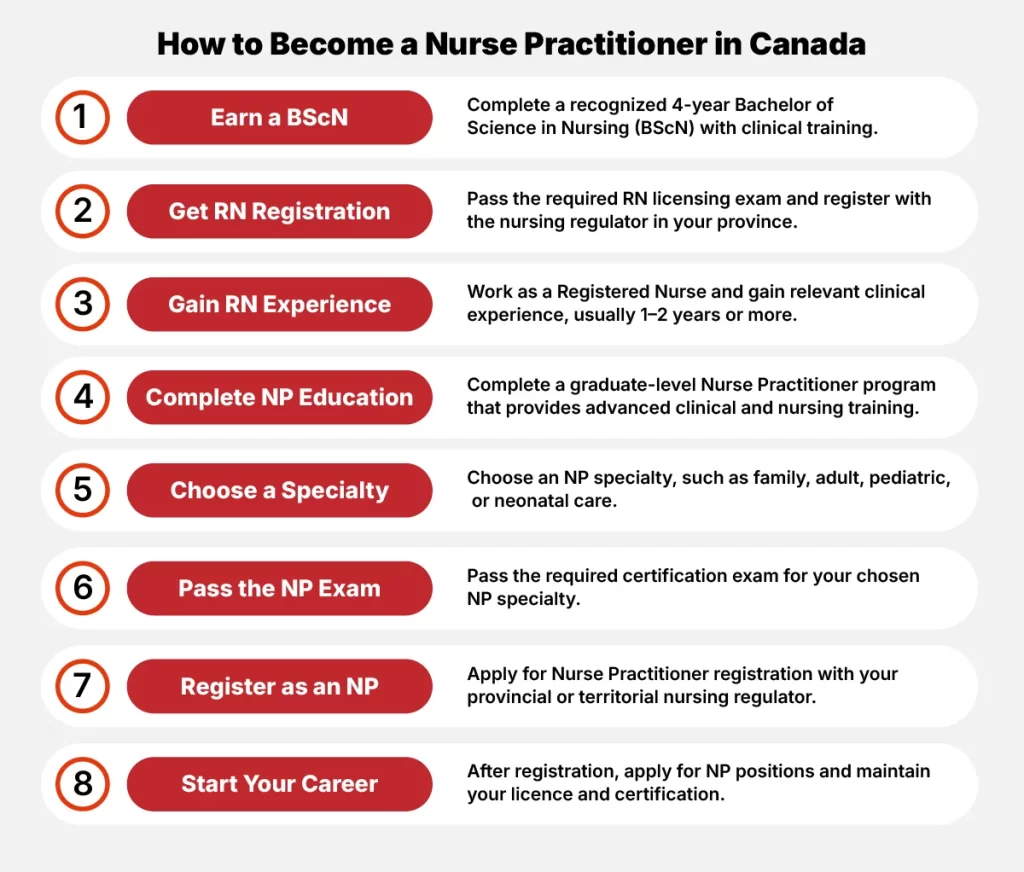
Step 1: Complete a Bachelor of Science in Nursing (BScN)
A 4-year accredited undergraduate degree is the mandatory entry point into nursing.
- Must be CASN-accredited
- Includes required clinical placements
Step 2: Pass the NCLEX-RN Exam
This licensing exam is required to practice as an RN in Canada (Quebec uses its own exam, OIIQ).
- Computer-adaptive test of clinical judgment and nursing knowledge
- Must pass before RN registration
Step 3: Register as an RN
Register with your province/territory’s nursing regulatory body to legally practice.
- Examples: CNO (Ontario), BCCNM (BC), CARNA (Alberta)
- Registration is province-specific
Step 4: Gain RN Clinical Experience
Before progressing further, most MN-NP programs require prior full-time RN experience before admission.
- Typically 1–2+ years, varies by school
- Primary care, ICU, or ER experience often preferred
Step 5: Complete a Master of Nursing – NP (MN-NP) Program
A 2-year graduate program providing advanced diagnostic, pharmacology, and clinical training.
- Choose a stream: Family/All-Ages, Adult, Pediatric, or Neonatal
- Includes 500–700+ supervised clinical practicum hours
Step 6: Pass the NP Certification Exam
A national or provincial exam validates readiness for independent advanced practice.
- E.g., Canadian Nurse Practitioner Exam (CNPE) via CNA
- Must match your MN-NP specialization stream
Step 7: Register as an NP
A separate designation from RN, granted after proof of MN-NP completion and exam pass.
- Grants authority to diagnose, prescribe, and order/interpret tests
- Apply through your provincial/territorial regulator
Step 8: Secure Employment and Maintain Licensure
Begin practicing, then meet ongoing requirements to keep your license active.
- Complete annual continuing education (CE) hours
- Meet minimum practice-hour requirements periodically
Nurse Practitioner Jobs in Canada
The Nurse Practitioner Jobs in Canada include:
- Primary Care/Family Practice nurses
- Hospital/Acute Care nurses
- Long-Term Care/Geriatrics nurse
- Pediatrics nurse
- Neonatal Care nurses
- Mental Health/Psychiatry nurses
- Remote/Rural & Indigenous Health nurses
- Public Health nurses
- Specialty Clinics nurse
- Occupational Health nurses
Nurse Practitioners in Canada can work across a range of Healthcare Jobs in Canada, depending on their specialization and patient population focus.
Nurse Practitioner Salary in Canada
The average salary of a Nurse Practitioner in Canada ranges from CAD 87,000 to CAD 156,000 per year, depending on experience, province, employer, and area of specialization, making it one of the highest-paying jobs in Canada.
Here is a simple breakdown of Nurse Practitioner salary in Canada based on experience level:
- Entry-Level Nurse Practitioner earns around CAD 70,000 – CAD 100,000 per year
- Mid-Level Nurse Practitioner earns around CAD 100,000 – CAD 120,000 per year
- Experienced Nurse Practitioner earns around CAD 120,000 – CAD 140,000 per year
- Senior / Specialized Nurse Practitioner earns around CAD 140,000 – CAD 175,000+ per year
Conclusion
Overall, becoming a Nurse Practitioner in Canada is a serious commitment in time and education, but it can also lead to a rewarding, in-demand career with strong earning potential. With an aging population, physician shortages, and expanding NP scopes of practice across provinces, qualified NPs will continue to be needed across primary care, hospitals, and specialized clinics for years to come.
For anyone considering this path, the combination of job security, competitive salary, and the ability to make a direct impact on patient care makes the Nurse Practitioner route a strong choice within Canada’s healthcare system, and you can explore current listings and wage data on Job Bank Canada.